




































Published at Energy Conversion and Management – Constructing a novel closed-loop and efficient pathway for multi-functional CO2 utilization in concentrated solar power systems – SolarPACES
Report on Novel Closed-Loop Pathway for Multi-Functional CO2 Utilization in Concentrated Solar Power Systems
Introduction
This report presents an innovative energy storage system integrating thermochemical and electrochemical cycles for concentrated solar power (CSP) applications. The system focuses on the multi-functional utilization of CO2, addressing key challenges in energy storage and release while aligning with the United Nations Sustainable Development Goals (SDGs), particularly SDG 7 (Affordable and Clean Energy), SDG 9 (Industry, Innovation, and Infrastructure), and SDG 13 (Climate Action).
System Overview
The proposed hybrid energy storage system constructs a closed-loop pathway comprising four stages:
- Heat Storage
- Electricity Storage
- Electricity Release
- Heat Release
This design enables efficient and low-cost green power production by utilizing CO2 in both thermochemical and electrochemical processes.
Performance Analysis
Energy Efficiency
- The thermoelectric cycle coupling improved the thermochemical subsystem’s round-trip efficiency to 37.78%, representing a 9.54% increase over conventional thermochemical systems.
- The electrochemical subsystem achieved a peak round-trip efficiency of 74.70%.
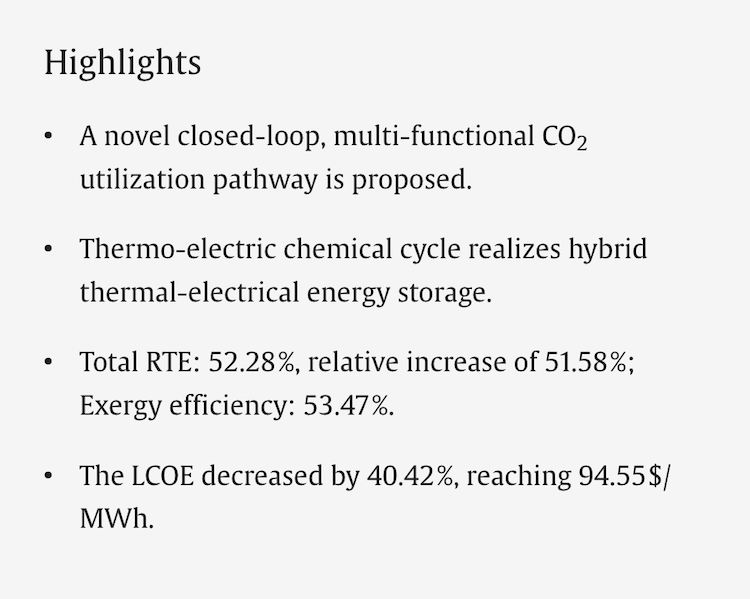
- The overall hybrid system reached a maximum round-trip efficiency of 52.28%.
Exergy Efficiency
- The thermochemical subsystem demonstrated an exergy efficiency of 41.55%.
- The hybrid system improved exergy efficiency to 53.47%, a relative increase of 28.69%.
Economic Evaluation
- The hybrid system achieved a levelized cost of energy (LCOE) of $94.55 per MWh.
- This cost represents a 40.42% reduction compared to conventional thermochemical storage systems.
Contribution to Sustainable Development Goals (SDGs)
- SDG 7 – Affordable and Clean Energy: The system promotes clean energy generation with enhanced efficiency and reduced costs, facilitating wider access to sustainable power.
- SDG 9 – Industry, Innovation, and Infrastructure: The novel closed-loop design exemplifies innovation in energy storage infrastructure, supporting resilient and sustainable industrial development.
- SDG 13 – Climate Action: By enabling efficient CO2 utilization and reducing reliance on fossil fuels, the system contributes to mitigating climate change impacts.
Conclusion
The hybrid thermochemical-electrochemical energy storage system demonstrates significant advancements in CO2 utilization for concentrated solar power. With improved efficiency, reduced costs, and alignment with critical SDGs, this technology holds great potential for sustainable energy solutions and climate change mitigation.
Reference
Yang Yu, Zhipeng Zhang, Binjian Nie, Nan He, Qicheng Chen, Zhihui Wang, Liang Yao, Constructing a novel closed-loop and efficient pathway for multi-functional CO2 utilization in concentrated solar power systems, Energy Conversion and Management, Volume 353, 2026, 121187, ISSN 0196-8904, https://doi.org/10.1016/j.enconman.2026.12118
1. Sustainable Development Goals (SDGs) Addressed
- SDG 7: Affordable and Clean Energy
- The article discusses the development of a hybrid energy storage system using solar thermochemical and electrochemical cycles, which contributes to clean and efficient energy production.
- SDG 13: Climate Action
- The focus on CO2 utilization and reduction of energy consumption in solar power generation aligns with efforts to combat climate change by reducing greenhouse gas emissions.
- SDG 9: Industry, Innovation and Infrastructure
- The article presents innovative technology for energy storage and conversion, promoting sustainable industrial development and infrastructure advancement.
2. Specific Targets Under the Identified SDGs
- SDG 7 Targets
- Target 7.2: Increase substantially the share of renewable energy in the global energy mix by developing efficient solar power systems.
- Target 7.3: Double the global rate of improvement in energy efficiency, as demonstrated by the increased round-trip efficiency of the hybrid system.
- SDG 13 Targets
- Target 13.2: Integrate climate change measures into national policies and strategies by promoting CO2 utilization technologies.
- SDG 9 Targets
- Target 9.4: Upgrade infrastructure and retrofit industries to make them sustainable, with increased resource-use efficiency and greater adoption of clean and environmentally sound technologies.
3. Indicators Mentioned or Implied for Measuring Progress
- Round-trip efficiency (%)
- Measured for both thermochemical (37.78%) and electrochemical (74.70%) subsystems, as well as the hybrid system (52.28%), indicating energy conversion efficiency improvements.
- Exergy efficiency (%)
- Thermochemical subsystem (41.55%) and hybrid system (53.47%) exergy efficiencies indicate the quality of energy utilization.
- Levelized Cost of Energy (LCOE) ($/MWh)
- The hybrid system’s LCOE of 94.55 $/MWh, showing a 40.42% reduction compared to conventional systems, measures economic viability and cost-effectiveness.
- CO2 Utilization
- Implied as a key metric for environmental impact and climate action, though not quantified directly in the article.
4. Table of SDGs, Targets, and Indicators
| SDGs | Targets | Indicators |
|---|---|---|
| SDG 7: Affordable and Clean Energy |
|
|
| SDG 13: Climate Action |
|
|
| SDG 9: Industry, Innovation and Infrastructure |
|
|
Source: solarpaces.org
What is Your Reaction?
 Like
0
Like
0
 Dislike
0
Dislike
0
 Love
0
Love
0
 Funny
0
Funny
0
 Angry
0
Angry
0
 Sad
0
Sad
0
 Wow
0
Wow
0