





























































Climate Change, Health and the Role of Geneva – Geneva Environment Network

Report on Climate Change and Health: Emphasizing Sustainable Development Goals (SDGs)
1. Importance of Addressing Climate Change for Health
Climate change is recognized as a critical global public health challenge, directly impacting environmental conditions and social determinants of health such as clean air, safe water, food security, and livelihoods. The World Health Organization (WHO) identifies climate change as a fundamental threat to human health and highlights its pressure on health systems worldwide. Research indicates that 1 in 12 hospitals globally face high risks of shutdown due to climate hazards, demonstrating vulnerability in health infrastructure.
The Intergovernmental Panel on Climate Change (IPCC) estimates that 3.6 billion people live in areas highly susceptible to climate change, exposing vast populations to health risks including increased illness and mortality. The Lancet Countdown reports intensifying health risks from heat exposure, extreme weather, and infectious diseases.
Without urgent action, WHO estimates approximately 250,000 additional deaths per year between 2030 and 2050 due to malnutrition, malaria, diarrheal diseases, and heat stress. Climate change acts as a “threat multiplier,” undermining progress in global health and development, and stressing health systems.
“Climate change is an unavoidable reality that challenges public health, threatens historic health achievements, and adds pressure on already overwhelmed systems. Protecting lives, reducing inequalities, and bolstering the resilience of health systems are ethical and democratic imperatives.”
– COP30 Special Report on Health and Climate Change by the Ministry of Health of Brazil and the WHO
2. Climate Change and Health: Key Impacts
Climate change affects health through multiple interconnected pathways, influencing both direct health outcomes and underlying determinants:
- Heat and Extreme Weather: Increased temperatures and frequent heatwaves, floods, storms, and wildfires lead to higher mortality, injuries, and health emergencies. Heat stress is a leading cause of climate-related deaths, especially among older populations.
- Air Pollution: Fossil fuel combustion and wildfires worsen air quality, increasing respiratory diseases, cardiovascular conditions, and cancers. Climate mitigation offers health co-benefits through cleaner air.
- Food and Water Security: Disruptions in agriculture and water systems affect food availability and quality, contributing to malnutrition and food insecurity. Changing rainfall patterns increase water scarcity and waterborne diseases.
- Infectious Diseases: Altered temperature and precipitation patterns change the distribution of vector-borne and waterborne diseases like malaria, dengue, and cholera.
- Mental Health: Climate disasters and environmental degradation contribute to anxiety, post-traumatic stress, and other mental health issues, compounded by social disruption and displacement.
These impacts are interconnected, creating complex risks for individuals and health systems.

Source: WHO
2.1 Impacts on Health Systems
Climate change strains health systems by damaging infrastructure, disrupting services, and increasing healthcare demand. Extreme heat causes hospital overcrowding and worsens patient outcomes. The health workforce faces reduced productivity and higher occupational risks. These pressures threaten progress towards Universal Health Coverage (UHC) and highlight the need for climate-resilient, sustainable health infrastructure.
3. Inequality and Vulnerability in Climate-Health Impacts
Health impacts of climate change are unevenly distributed, disproportionately affecting those least responsible for emissions:
- Low-income countries, small island developing states, and fragile contexts face the greatest risks due to limited resources and weaker health infrastructure. One billion people in low- and lower-middle-income countries rely on healthcare facilities with unreliable or no electricity.
- Vulnerable populations including children, elderly, migrants, and those with pre-existing conditions are more exposed to climate-sensitive health risks.
Factors Shaping Vulnerability and Risk:
Vulnerability depends on exposure to climate hazards, sensitivity of populations and systems, and capacity to adapt and respond, explaining differing health outcomes across regions.
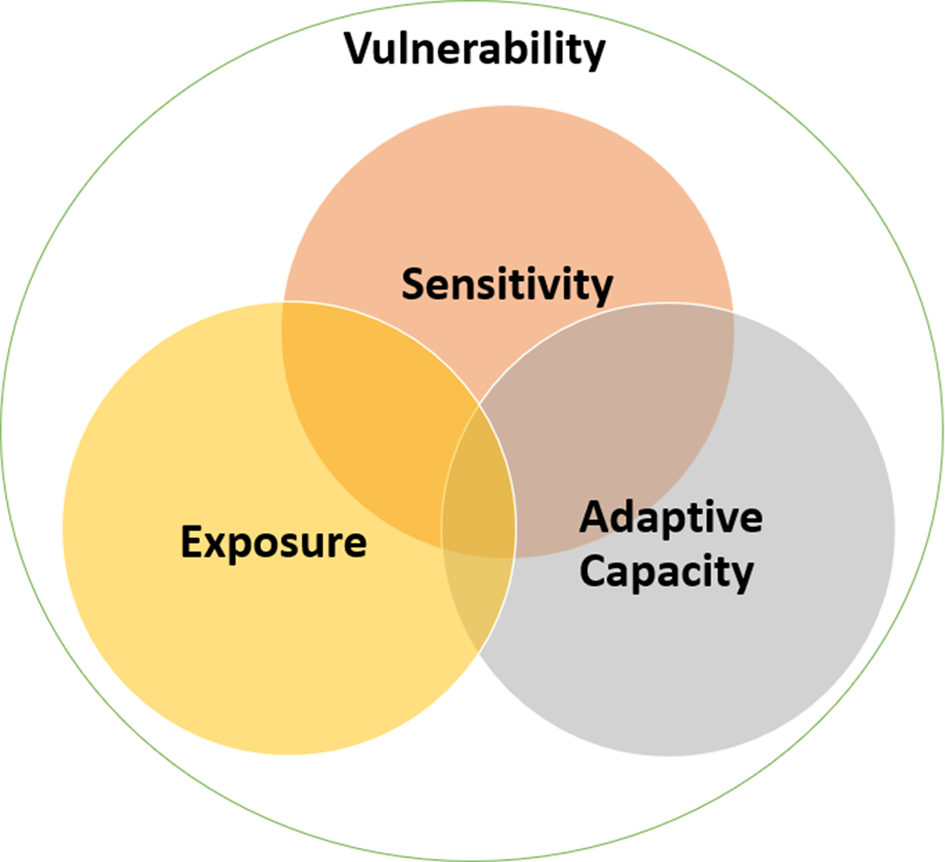
Source: Adapted from Springer Nature Article on Climate Vulnerability (2026)
4. Human Rights-Based Approach to Climate Change and Health
Climate change is also a human rights issue, affecting rights to health, life, food, water, housing, development, and a clean environment. The UN Human Rights Council and General Assembly affirm the importance of a healthy environment for full enjoyment of human rights.
A human rights-based approach includes:
- Right to Health and Underlying Conditions: Extends beyond healthcare access to include clean air, safe water, adequate food, and a healthy environment. Climate change impacts physical and mental health, including anxiety and trauma.
- Access to Participation, Information, and Justice: Emphasizes community engagement in climate and health policy for inclusive and equitable responses.
- Translating Commitments into Implementation: Requires states to respect, protect, and fulfill health rights through mitigation, adaptation, information access, participation, accountability, resource allocation, and monitoring.
This approach prioritizes equity, participation, accountability, and non-discrimination, aligning with Sustainable Development Goals such as SDG 3 (Good Health and Well-being), SDG 6 (Clean Water and Sanitation), SDG 10 (Reduced Inequalities), and SDG 13 (Climate Action).
4.1 Human Rights Instruments Addressing Climate and Health
Human rights mechanisms in Geneva, including the Human Rights Council, Special Procedures, and Treaty Bodies, play pivotal roles in addressing climate-related health impacts and clarifying state obligations.
- Human Rights Treaty Bodies: Committees monitor treaty implementation and have issued statements and recommendations linking climate change, health, and human rights. Examples include:
- Committee on Economic, Social and Cultural Rights – General Comment No. 27 (2025) on environmental dimensions of sustainable development.
- Committee on the Rights of the Child – General Comment No. 26 (2023) on children’s rights and environment with focus on climate change.
- Office of the High Commissioner for Human Rights (OHCHR): Highlights climate change as a profound threat to the right to health, presenting analytical studies and facilitating policy guidance.
- Special Procedures of the Human Rights Council: Independent experts produce reports on issues such as clean air, fossil fuel phase-out, and health rights, emphasizing the intersection of climate and health.
“Limiting warming to 1.5°C above pre-industrial levels is essential. Protecting the right to health requires rights-based, effective, participatory climate mitigation and adaptation benefiting vulnerable populations.”
– Analytical study on climate change and the right to health (A/HRC/32/23)
5. Climate Action as an Opportunity for Health Improvement
Climate action offers significant public health and economic benefits through mitigation and adaptation measures that deliver health co-benefits:
- Improving Air Quality: Reducing emissions improves air quality, potentially preventing around 7 million premature deaths annually (WHO), decreasing respiratory and cardiovascular diseases.
- Promoting Healthier Diets: Sustainable food systems support nutrition and reduce environmental pressures.
- Encouraging Active Mobility: Urban policies promoting walking and cycling reduce emissions and improve physical and mental health.
- Strengthening Health Systems: Investing in climate-resilient, sustainable health infrastructure improves preparedness and care continuity.
Economic benefits include reduced healthcare costs and increased productivity. Studies show health benefits of mitigation can match or exceed climate action costs. For example, investments in resilient energy for healthcare could avert thousands of deaths and generate significant economic returns in countries like Tanzania and Pakistan.
These findings underscore climate action as both an environmental necessity and a public health opportunity, requiring integrated, equitable, and human rights-aligned approaches consistent with SDGs 3, 7 (Affordable and Clean Energy), 11 (Sustainable Cities and Communities), and 13.
6. Global Initiatives Addressing Climate Change and Health
International initiatives focus on strengthening health systems, mobilizing finance, generating evidence, and integrating health into climate governance:
6.1 Alliance for Transformative Action on Climate and Health (ATACH)
ATACH supports over 100 countries in building climate-resilient, low-carbon health systems, translating COP26 commitments into action. It facilitates:
- Development of national adaptation plans and vulnerability assessments
- Access to climate finance for health
- Integration of climate and health policies
Five thematic working groups address financing, resilience, low-carbon systems, supply chains, and nutrition.
6.2 Belém Health Action Plan (BHAP) at COP30
BHAP places health at the center of climate adaptation, focusing on:
- Strengthening system flexibility and resilience
- Advancing health equity
- Scaling up climate-health finance
- Investing in evaluation systems
- Accelerating mitigation to protect health
Supported by the Climate and Health Funders Coalition, BHAP provides a framework for health-centered climate action.
6.3 Children’s Environmental Health Collaborative
Launched by UNICEF, UNEP, and the World Bank, this initiative protects children’s health from climate and environmental risks by:
- Advocating for policy change prioritizing children’s environmental health
- Strengthening evidence and data sharing
- Catalyzing implementation linking global dialogue with country action
6.4 COP28 Declaration on Climate and Health
Adopted by over 120 countries, the Declaration commits to:
- Strengthening climate-resilient health systems
- Reducing health sector emissions
- Integrating health into climate policies
- Improving preparedness for climate-related health risks
The Declaration mobilized over $1 billion for climate and health action and established the first Health Day at a COP.
6.5 UNICEF Healthy Environments for Healthy Children Initiative
This initiative aims to prevent 26% of deaths in children under five by addressing environmental risks, supporting integration of climate considerations into health, education, and community programs. Key actions include:
- Mobilizing collective action
- Enhancing primary health care
- Improving resilience in health facilities
- Integrating climate and environmental education
- Empowering children and youth as agents of change
6.6 Global Action Plan on Climate Change and Health (2025-2028)
Adopted by WHO Member States, the plan prioritizes:
- Integrating health into climate policies
- Strengthening evidence base
- Advancing adaptation and mitigation
- Ensuring climate-resilient, sustainable health systems
6.7 Global Climate and Health Alliance
A network of over 200 organizations and 46 million health professionals advocating for health-centered climate action by:
- Mobilizing the climate and health community
- Influencing policy and legal frameworks
- Advocating equitable fossil fuel phase-out
- Strengthening research and evidence
- Engaging the public on health risks
6.8 World Economic Forum (WEF) Climate and Health Initiative
WEF addresses systemic climate-health impacts across economies, focusing on:
- Strengthening workforce resilience
- Generating economic and health impact evidence
- Assessing and supporting adaptation strategies
- Mobilizing finance and partnerships
- Facilitating multi-stakeholder collaboration
7. Role of Geneva in Climate Change and Health
7.1 International Geneva
Geneva hosts UN entities, international organizations, research institutions, and civil society, providing a platform for norm-setting, scientific assessment, policy coordination, and dialogue on climate and health.
Food and Agriculture Organization (FAO)
FAO addresses climate-health links through agrifood systems, food security, and nutrition, promoting resilient, sustainable, health-sensitive food systems and participating in the Quadripartite One Health collaboration.
Global Fund to Fight AIDS, Tuberculosis and Malaria
The Global Fund integrates climate considerations into health programs, supporting climate-resilient health systems and financing through initiatives like the Climate and Health Catalytic Fund.
International Committee of the Red Cross (ICRC)
ICRC addresses the “triple threat” of climate change, conflict, and health emergencies, strengthening resilience in fragile settings.
Intergovernmental Panel on Climate Change (IPCC)
IPCC provides scientific evidence on climate impacts on health, emphasizing climate change as a risk multiplier and the need for integrated approaches.
International Labour Organization (ILO)
ILO focuses on occupational health risks from climate change, promoting safe, climate-resilient work environments.
Médecins Sans Frontières (MSF)
MSF delivers medical assistance in climate-affected contexts and advocates for attention to climate-health impacts.
Office of the High Commissioner for Human Rights (OHCHR)
OHCHR advances a human rights-based approach to climate and health, promoting accountability and equity.
United Nations Development Programme (UNDP)
UNDP supports integration of climate and health into development planning and adaptation strategies.
United Nations Environment Programme (UNEP)
UNEP advances environmental health dimensions, including pollution and ecosystem degradation, supporting integrated climate-health responses.
United Nations Children’s Fund (UNICEF)
UNICEF addresses disproportionate climate impacts on children’s health and supports child-centered climate-health initiatives.
World Economic Forum (WEF)
WEF promotes economic perspectives on climate-health risks, mobilizing investment and collaboration.
World Health Organization (WHO)
WHO leads global climate and health efforts, providing guidance and supporting climate-resilient health systems through initiatives like the WHO Global Strategy on Health, Environment and Climate Change.
WHO-WMO Joint Climate and Health Programme
This programme strengthens climate-informed health decision-making by linking meteorological services with health authorities, including early warning systems for climate-related health risks.
7.2 Swiss and Geneva-based Initiatives
Switzerland and Geneva host academic, policy, and research actors advancing the climate-health agenda:
Climate Action Accelerator (CAA)
CAA supports climate-smart healthcare models and decarbonization roadmaps in multiple countries, providing tools for vulnerability assessments and implementation support.
Geneva Graduate Institute
The Institute conducts research and policy analysis on climate, health, and development, hosting centers focused on global health governance and sustainability.
Swiss Tropical and Public Health Institute (Swiss TPH)
Swiss TPH researches climate-related health impacts, including vector-borne diseases and heat-related health risks, supporting surveillance and adaptation strategies globally.
University of Geneva
The University offers interdisciplinary education and research on planetary health and climate-health linkages, training professionals for integrated climate and health responses.
8. Conclusion
Addressing climate change is essential for protecting global health and achieving the Sustainable Development Goals, particularly SDG 3 (Good Health and Well-being), SDG 6 (Clean Water and Sanitation), SDG 10 (Reduced Inequalities), and SDG 13 (Climate Action). Integrated, equitable, and human rights-based approaches are critical to strengthening health systems, reducing vulnerabilities, and leveraging climate action as an opportunity to improve public health and sustainable development worldwide.
1. Sustainable Development Goals (SDGs) Addressed in the Article
- SDG 3: Good Health and Well-being – The article focuses extensively on health impacts of climate change, including increased mortality, disease burden, and health system resilience.
- SDG 6: Clean Water and Sanitation – Climate change impacts on water security and waterborne diseases are discussed.
- SDG 7: Affordable and Clean Energy – The article highlights the importance of resilient energy access in healthcare facilities.
- SDG 10: Reduced Inequalities – Unequal distribution of climate health impacts on vulnerable populations and low-income countries is emphasized.
- SDG 13: Climate Action – Central to the article, focusing on mitigation, adaptation, and integration of health into climate policies.
- SDG 16: Peace, Justice and Strong Institutions – Through the human rights-based approach to climate and health, including access to justice and participation.
- SDG 17: Partnerships for the Goals – The article describes numerous global partnerships and initiatives addressing climate and health.
2. Specific Targets Under Identified SDGs
- SDG 3 (Good Health and Well-being)
- Target 3.8: Achieve universal health coverage, including financial risk protection and access to quality essential health-care services.
- Target 3.d: Strengthen the capacity of all countries for early warning, risk reduction, and management of health risks.
- SDG 6 (Clean Water and Sanitation)
- Target 6.1: Achieve universal and equitable access to safe and affordable drinking water.
- Target 6.2: Achieve access to adequate and equitable sanitation and hygiene.
- SDG 7 (Affordable and Clean Energy)
- Target 7.1: Ensure universal access to affordable, reliable, and modern energy services.
- SDG 10 (Reduced Inequalities)
- Target 10.2: Empower and promote the social, economic and political inclusion of all.
- SDG 13 (Climate Action)
- Target 13.1: Strengthen resilience and adaptive capacity to climate-related hazards and natural disasters.
- Target 13.2: Integrate climate change measures into national policies, strategies and planning.
- Target 13.3: Improve education, awareness-raising and human and institutional capacity on climate change mitigation, adaptation, impact reduction and early warning.
- SDG 16 (Peace, Justice and Strong Institutions)
- Target 16.7: Ensure responsive, inclusive, participatory and representative decision-making at all levels.
- SDG 17 (Partnerships for the Goals)
- Target 17.17: Encourage and promote effective public, public-private and civil society partnerships.
3. Indicators Mentioned or Implied to Measure Progress
- Health System Resilience Indicators: Number of hospitals at risk of climate hazards; capacity of health systems to respond to climate-related health emergencies.
- Mortality and Morbidity Rates: Additional deaths per year due to climate-related causes (e.g., 250,000 additional deaths between 2030-2050); incidence of climate-sensitive diseases such as malaria, dengue, diarrhoeal diseases.
- Access to Services: Proportion of healthcare facilities with reliable access to electricity; access to clean air, safe water, and adequate food.
- Climate Finance Mobilization: Amount of climate and health finance mobilized (e.g., over $1 billion commitments at COP28).
- Participation and Equity Metrics: Inclusion of vulnerable populations in climate-health policies; measures of health equity and reduction of inequalities.
- Emission Reduction Indicators: Reduction in emissions from the health sector; progress in phasing out fossil fuels.
- Early Warning Systems: Implementation and effectiveness of climate-informed health early warning systems (e.g., heat health information networks).
4. Table of SDGs, Targets and Indicators
| SDGs | Targets | Indicators |
|---|---|---|
| SDG 3: Good Health and Well-being |
|
|
| SDG 6: Clean Water and Sanitation |
|
|
| SDG 7: Affordable and Clean Energy |
|
|
| SDG 10: Reduced Inequalities |
|
|
| SDG 13: Climate Action |
|
|
| SDG 16: Peace, Justice and Strong Institutions |
|
|
| SDG 17: Partnerships for the Goals |
|
|
Source: genevaenvironmentnetwork.org
What is Your Reaction?
 Like
0
Like
0
 Dislike
0
Dislike
0
 Love
0
Love
0
 Funny
0
Funny
0
 Angry
0
Angry
0
 Sad
0
Sad
0
 Wow
0
Wow
0