

























































Bridging Mobility, Industry, and Policy Innovation
It’s a recap of Morocco’s showcase at Transport and Climate Change Week 2025 in Berlin, highlighting how the country links mobility policy, industry, and finance to decarbonise transport. The piece notes trainings on clean-vehicle standards, financing, and informal transport reform; a presentation on Morocco’s FRAT fund for public-transport upgrades; discussion of the nation’s growing role in automotive and EV value chains; and an Africa Dialogue session on aligning national actions with regional net-zero goals. The overarching message is that progress depends on cross-sector coordination, practical tools, and international partnerships.

Bridging Mobility, Industry, and Policy Innovation
Morocco Showcases Its Sustainable Transport Approach at the 2025 Transport and Climate Change Week in Berlin
The global community is slowly advancing a comprehensive decarbonisation of the transport sector, as most recently demonstrated at the COP30 with an emphasis on transitioning energy, industry, and transport away from fossil fuels—an ambition well reflected in Morocco’s cross-sectoral approach. Morocco’s position in the global automotive industry is gaining recognition, its recently updated Nationally Determined Contributions (NDCs) show a reinforced commitment to energy and transport decarbonisation, and preparations for the Africa Cup of Nations 2025 and 2030 World Cup are in full gear. In this context, this year’s Transport and Climate Change Week (TCCW) presented a unique opportunity to showcase the country’s achievements and ambitions, to build further its expertise – from emissions testing to climate finance – and to deepen international dialogue and cooperation in the transport sector in Africa and beyond.
From 22 to 26 September 2025, the 8th Transport and Climate Change Week (TCCW) brought mobility practitioners from more than 30 countries to Berlin under the theme “Time to be Accountable.” Organised by GIZ with the support of the International Climate Initiative (IKI) of the Federal Government of Germany,[1] the annual event serves as a global platform to share best practices, foster dialogue, and advance solutions for decarbonising the transport sector.
The Moroccan delegation at the TCCW 2025, institutional partners of the projects DKTI VI and IMPROVE, participated actively in the conference programme. Reflecting the country’s ambition and growing role as regional leader in sustainable mobility and decarbonisation, the representatives shared achievements, strategies, and engaged with the experiences of other countries presented throughout the week.
Training on Vehicle Efficiency in Dresden
Part of the Moroccan delegation’s journey began on Monday, 22 September, in Dresden, where partners of the IMPROVE project—Ministry of Transport and Logistics (MTL) and the National Agency for Road Safety (NARSA)—participated in a guided visit to the Dresden University of Technology’s vehicle emissions laboratory. Led by Prof. Dr. Frank Atzler, the visit offered an in-depth look into how vehicle emissions are measured and analysed, providing valuable technical insights into data-based policymaking for vehicle efficiency standards.
Morocco’s Perspective in the Opening Plenary
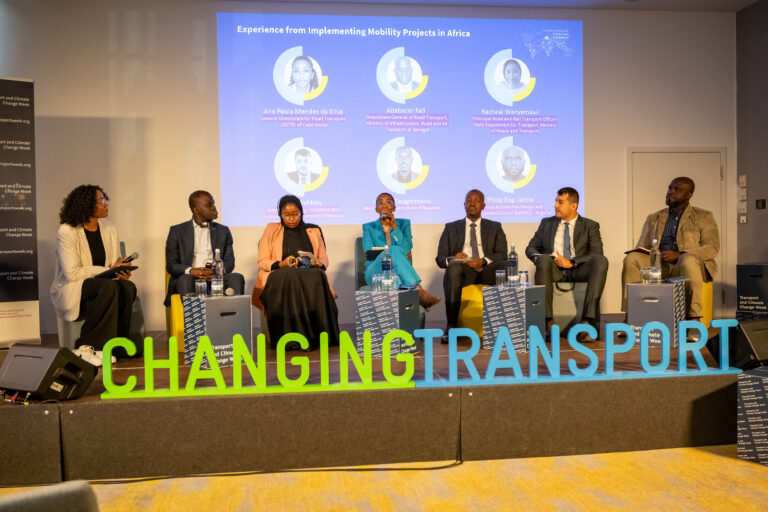
During the official opening of TCCW on Tuesday, 23 September—in the first Country Perspectives session of the week—representatives from several African countries highlighted shared ambitions and national strategies for climate-friendly mobility. Mr Nabil Dahhou, Head of Service for Strategy & Planning at the Ministry of Energy Transition and Sustainable Development (MTEDD), outlined Morocco’s integrated approach to advancing both the energy and transport transitions. He highlighted Morocco’s strong commitment to climate action through the Long-term Low Carbon Strategy 2050 (French) and the National Strategy for Sustainable Development (French). Mr. Dahhou emphasised the synergies between renewable energy and sustainable mobility, describing them as essential drivers of Morocco’s low-carbon development agenda and its national climate objectives.
Thematic Trainings
The representatives of Morocco took part in three thematic trainings addressing central challenges of the transport transition.
The first, “Regulating the Transition to Clean Vehicles,” explored vehicle efficiency standards, emissions monitoring, effective industrial dialogue, and data management. The second, “Financing and Funding Approaches for Mobility,” organised by the EBRD, examined how to mobilise climate finance and effectively prepare sustainable transport projects. The third, “Decarbonising Informal Transport: Roadmaps for Reform,” addressed how paratransit systems—such as shared taxis and minibuses—can be integrated into urban mobility planning.
These sessions offered opportunities for exchange between countries at different stages of the mobility transition, and provided participants with actionable tools to advance policy development and implementation at home.
Presentation on the FRAT
Mr Essaid Fraigui, Head of the Fonds d’Accompagnement des Réformes au Transport (FRAT),presented to participants of the financing training the unique role played the FRAT, a financial instrument of the Ministry of the Interior. He explained how the FRAT was established to support public transport reform and finance major infrastructure projects, such as BRT and tramway networks. Mr Fraigui’s presentation offered an inspiring example of how national funding instruments can catalyse investments in sustainable mobility and strengthen institutional frameworks for transport reform.
The Moroccan delegation embarked on a transport-focused tour through central Berlin, experiencing the city’s integrated public transport network firsthand. Visiting Berlin’s mobility hubs operated by BVG and accessible through the Mobility-as-a-Service app Jelbi, participants observed how digitalisation, multimodality, and public–private cooperation can facilitate sustainable mobility solutions for urban residents.
Morocco’s Role in the Future of Automotive Value Chains
On Thursday, 25 September, Mr Karim Ben Amara, Head of Service for Sustainable Mobility at the MTL joined a panel discussion entitled “Driving Transitions: The Future of Automotive Industry Value Chains in a Changing Global Landscape.” The panel, moderated by Christian Hochfeld (Agora Verkehrswende), also included Ms Annika Berlin (UNEP), Dr Juma Mukhwana (Kenya’s Ministry of Investment, Trade & Industry), and Mr Li Disi (China’s GSTIKC). Mr Ben Amara showcased Morocco’s increasing significance in global automotive value chains, highlighting ongoing investments in battery and (electric) vehicle production. He emphasised the country’s commitment to aligning industrial development with decarbonisation objectives and international climate goals.
Showcasing National Strategies in the Africa Dialogue
The week concluded with the Africa Dialogue session entitled “Accountability in Motion – Linking National to Regional Impact in the Transition to Net-Zero Mobility.” Mrs Dounia Squali, Head of Division for Sustainable Mobility and Innovation at the MTL presented Morocco’s national policies for transport decarbonisation, including measures for fleet renewal and the design of an incentive mechanism for low-emission vehicles, a central part of the IMPROVE project. The session fostered exchanges among African representatives, strengthening regional collaboration and mutual learning.
The 8th Transport and Climate Change Week demonstrated that achieving a sustainable, low-carbon transport future depends on international partnerships, shared accountability, and continued dialogue between governments, public and private stakeholders, and citizens alike.
The Sustainable Mobility with Renewable Energies in Morocco (DKTI VI) project is and is commissioned by the German Federal Ministry for Economic Cooperation and Development (BMZ) and implemented by the Deutsche Gesellschaft für Internationale Zusammenarbeit (GIZ) GmbH in partnership with the Moroccan Ministry of Energy Transition and Sustainable Development (MTEDD) and the City of Agadir.
The IMPROVE project is implemented by the Deutsche Gesellschaft für Internationale Zusammenarbeit (GIZ) GmbH and is funded through the International Climate Initiative (IKI) of the German Federal Ministry for Environment, Nature Conservation Climate Action and Nuclear Safety (BMUKN). It supports partner ministries in Colombia, Kenya, Morocco and Thailand to develop policies and regulations that support the transition to cleaner and more energy efficient vehicles.
What is Your Reaction?
 Like
0
Like
0
 Dislike
0
Dislike
0
 Love
0
Love
0
 Funny
0
Funny
0
 Angry
0
Angry
0
 Sad
0
Sad
0
 Wow
0
Wow
0