





































Female labor force participation rate – Our World in Data
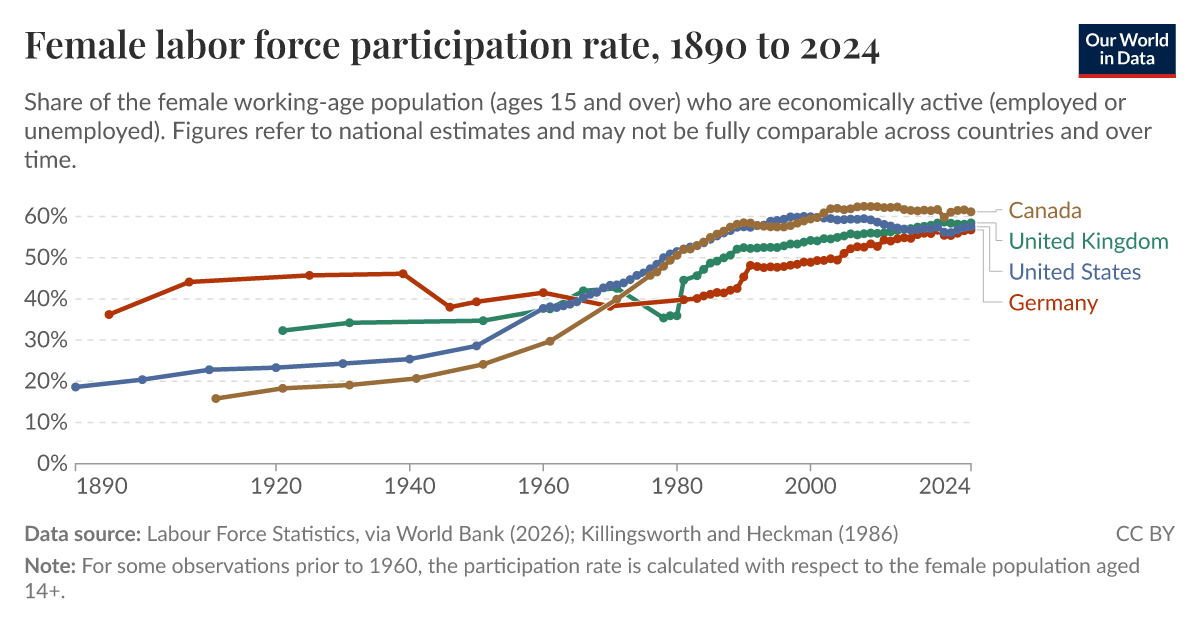
Report on Female Labor Force Participation: Historical Data and Sustainable Development Goals
Introduction
This report presents a comprehensive analysis of female labor force participation using long-run data sources combined to ensure consistency and relevance. The data integrates historical records from Killingsworth and Heckman (1986) with contemporary statistics from ILOSTAT and the World Bank’s World Development Indicators. Emphasis is placed on the alignment of female labor participation trends with the Sustainable Development Goals (SDGs), particularly SDG 5 (Gender Equality) and SDG 8 (Decent Work and Economic Growth).
Data Sources and Methodology
- Historical data from Killingsworth and Heckman (1986) provided long-term female labor participation rates.
- Recent data were sourced from ILOSTAT and the World Bank’s World Development Indicators to reflect the most current national estimates.
- When overlapping data existed for the same year, preference was given to ILOSTAT data to maintain consistency with recent trends.
Country-Specific Data Timelines
The latest year available from Killingsworth and Heckman (1986) varies by country as follows:
- Canada: 1951
- Germany: 1981
- United Kingdom: 1951
- United States: 1950
Data Considerations for Germany
Special attention was given to the German data for the year 1939, where two values existed:
- One reflecting post-World War I borders.
- Another reflecting West Germany borders (excluding Berlin).
The dataset adopts the latter value, consistent with the overall dataset conventions.
Relevance to Sustainable Development Goals
Tracking female labor force participation is critical to advancing several SDGs:
- SDG 5: Gender Equality – Increasing women’s participation in the labor market promotes gender equality and empowers women economically.
- SDG 8: Decent Work and Economic Growth – Enhancing female labor participation supports inclusive economic growth and productive employment for all.
- SDG 10: Reduced Inequalities – Monitoring labor participation helps identify and reduce disparities between genders and regions.
Conclusion
The integration of historical and contemporary data on female labor force participation provides valuable insights into progress towards gender equality and economic inclusion. Continued monitoring aligned with SDG targets is essential for policy development and achieving sustainable development outcomes globally.
1. Sustainable Development Goals (SDGs) Addressed or Connected
- SDG 5: Gender Equality
- The article discusses female labor force participation, directly relating to gender equality in employment opportunities.
- SDG 8: Decent Work and Economic Growth
- Labor force participation data is relevant to promoting sustained, inclusive economic growth and productive employment.
- SDG 17: Partnerships for the Goals
- The article references data from international organizations like ILOSTAT and the World Bank, highlighting global partnerships and data sharing.
2. Specific Targets Under Those SDGs
- SDG 5: Gender Equality
- Target 5.5: Ensure women’s full and effective participation and equal opportunities for leadership at all levels of decision-making in political, economic and public life.
- SDG 8: Decent Work and Economic Growth
- Target 8.5: Achieve full and productive employment and decent work for all women and men, including young people and persons with disabilities, and equal pay for work of equal value.
- SDG 17: Partnerships for the Goals
- Target 17.18: Enhance capacity-building support to developing countries to increase significantly the availability of high-quality, timely and reliable data.
3. Indicators Mentioned or Implied to Measure Progress
- Indicator for SDG 5.5
- Proportion of women in the labor force compared to men, as implied by the female labor force participation data presented.
- Indicator for SDG 8.5
- Employment-to-population ratio, by sex, age and persons with disabilities, as implied by the labor force participation statistics.
- Indicator for SDG 17.18
- Proportion of countries that have achieved timely availability of data from international sources such as ILOSTAT and World Bank, as the article references data consistency and updates.
4. Table of SDGs, Targets and Indicators
| SDGs | Targets | Indicators |
|---|---|---|
| SDG 5: Gender Equality | Target 5.5: Ensure women’s full and effective participation and equal opportunities for leadership at all levels. | Proportion of women in the labor force compared to men (female labor force participation rate). |
| SDG 8: Decent Work and Economic Growth | Target 8.5: Achieve full and productive employment and decent work for all women and men. | Employment-to-population ratio, by sex and age. |
| SDG 17: Partnerships for the Goals | Target 17.18: Enhance capacity-building support to increase availability of high-quality, timely and reliable data. | Proportion of countries with timely availability of labor force data from international sources (e.g., ILOSTAT, World Bank). |
Source: ourworldindata.org
What is Your Reaction?
 Like
0
Like
0
 Dislike
0
Dislike
0
 Love
0
Love
0
 Funny
0
Funny
0
 Angry
0
Angry
0
 Sad
0
Sad
0
 Wow
0
Wow
0