























































Slowing the ripening process to improve post-harvest quality – FoodProcessing.com.au
Report on Melatonin’s Role in Delaying Apple Ripening and Advancing Sustainable Development Goals
Introduction: Addressing Post-Harvest Loss in Line with SDG 2 and SDG 12
The post-harvest storage of climacteric fruits, such as apples, presents a significant challenge to global food security. Improper storage techniques lead to accelerated ripening and substantial food loss, directly undermining Sustainable Development Goal 2 (Zero Hunger) by reducing the availability of nutritious food. Furthermore, this waste contravenes the principles of Sustainable Development Goal 12 (Responsible Consumption and Production), which calls for reducing food losses along production and supply chains. Research into natural methods for preserving fruit quality is therefore critical for advancing these global objectives.
Research Objective and Scientific Context
A research team from Shenyang Agricultural University has investigated the molecular mechanisms governing fruit ripening to develop sustainable preservation strategies. The study focused on the interaction between two key hormones:
- Ethylene: The primary hormonal driver that accelerates ripening in climacteric fruits, leading to changes in colour, texture, and aroma, thereby shortening shelf life.
- Melatonin: A compound known to regulate plant growth and stress responses, but its specific role in controlling ethylene production during ripening was previously undefined.
Understanding this interaction is essential for developing innovative solutions that support SDG 9 (Industry, Innovation, and Infrastructure) by creating more resilient and sustainable agricultural systems.
Key Findings: The Molecular Pathway Regulating Ripening
The study successfully identified the precise molecular cascade through which melatonin delays apple ripening. The findings reveal that melatonin’s primary function is to regulate ethylene production at the transcriptional level.
The MdREM10 Regulatory Hub
The research pinpointed a key transcription factor, MdREM10, as the central link between melatonin signaling and ethylene biosynthesis. Experimental observations confirmed this relationship:
- During natural ripening, melatonin levels were observed to decrease as ethylene levels increased.
- Treatment with external melatonin successfully reduced ethylene production and delayed the ripening process.
- Transcriptomic analysis of melatonin-treated apples showed that the expression of the MdREM10 gene was strongly suppressed.
The Two-Branch Transcriptional Cascade
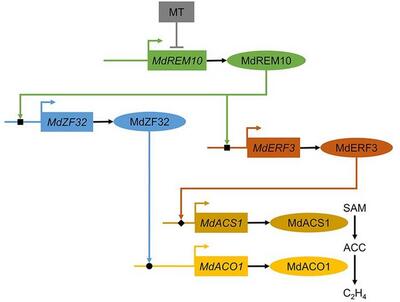
The study elucidated a two-branch regulatory pathway controlled by MdREM10, which directly activates the core genes responsible for ethylene production (MdACS1 and MdACO1). Melatonin disrupts this entire process by downregulating MdREM10.
- Pathway 1: MdREM10 binds to and activates the transcription factor MdERF3, which in turn promotes the expression of the ethylene synthesis gene MdACS1.
- Pathway 2: MdREM10 also binds to and activates the transcription factor MdZF32, which enhances the expression of the second key ethylene synthesis gene, MdACO1.
By suppressing MdREM10, melatonin effectively blocks both pathways, thereby slowing ethylene production and delaying fruit ripening.
Conclusion: Implications for Sustainable Development
This research provides a foundational mechanistic understanding of melatonin’s ability to preserve post-harvest fruit quality. The discovery of the MdREM10 regulatory hub offers a significant opportunity to develop natural and sustainable strategies to extend the shelf life of produce.
The application of these findings directly supports several Sustainable Development Goals:
- SDG 2 (Zero Hunger): By reducing post-harvest food losses, this innovation can increase food availability and contribute to global food security.
- SDG 12 (Responsible Consumption and Production): The research promotes more sustainable supply chains by providing a natural method to minimize food waste.
- SDG 9 (Industry, Innovation, and Infrastructure): This scientific breakthrough represents a key innovation that can be integrated into the agricultural and food storage industries to enhance efficiency and sustainability.
Analysis of Sustainable Development Goals (SDGs) in the Article
1. Which SDGs are addressed or connected to the issues highlighted in the article?
-
SDG 2: Zero Hunger
The article’s central theme of reducing post-harvest fruit loss directly contributes to increasing food availability and stability. By developing strategies to “maintain fruit quality” and “reduce postharvest losses,” the research supports the goal of ending hunger and ensuring a stable food supply.
-
SDG 12: Responsible Consumption and Production
This goal is directly addressed through the focus on food loss. The article explicitly mentions the need to “reduce postharvest losses,” which is a key component of ensuring sustainable consumption and production patterns. The research offers a “sustainable strategy” to make food supply chains more efficient and less wasteful.
-
SDG 9: Industry, Innovation, and Infrastructure
The article details a scientific discovery from an agricultural university. This represents an advancement in scientific research and innovation aimed at solving a practical problem within the agricultural industry. The findings provide “new opportunities to control postharvest quality,” which is a form of technological and scientific progress relevant to this goal.
2. What specific targets under those SDGs can be identified based on the article’s content?
-
SDG 2: Zero Hunger
-
Target 2.1: By 2030, end hunger and ensure access by all people… to safe, nutritious and sufficient food all year round.
The research aims to prevent the “significant loss of the fruit value” and “shortens shelf life” of apples. By extending the shelf life and maintaining the quality of fruit, this innovation helps increase the availability of nutritious food, contributing to food security.
-
Target 2.4: By 2030, ensure sustainable food production systems and implement resilient agricultural practices…
The article highlights the development of “sustainable strategies to maintain fruit quality” by understanding “natural regulatory pathways.” This approach aligns with creating more sustainable and resilient post-harvest management systems that rely on biological understanding rather than potentially harmful chemical interventions.
-
Target 2.1: By 2030, end hunger and ensure access by all people… to safe, nutritious and sufficient food all year round.
-
SDG 12: Responsible Consumption and Production
-
Target 12.3: By 2030, halve per capita global food waste at the retail and consumer levels and reduce food losses along production and supply chains, including post-harvest losses.
This is the most directly relevant target. The article’s entire premise is built around finding a solution to “reduce postharvest losses.” The discovery of how melatonin delays ripening is presented as a direct method to achieve this objective within the food supply chain.
-
Target 12.3: By 2030, halve per capita global food waste at the retail and consumer levels and reduce food losses along production and supply chains, including post-harvest losses.
-
SDG 9: Industry, Innovation, and Infrastructure
-
Target 9.5: Enhance scientific research, upgrade the technological capabilities of industrial sectors in all countries…
The study published in Horticulture Research is a clear example of enhanced scientific research. The article states, “This discovery not only advances fundamental understanding of fruit physiology but also highlights new opportunities to control postharvest quality,” directly contributing to upgrading the technological capabilities of the agriculture and food storage industries.
-
Target 9.5: Enhance scientific research, upgrade the technological capabilities of industrial sectors in all countries…
3. Are there any indicators mentioned or implied in the article that can be used to measure progress towards the identified targets?
-
Indicator 12.3.1: (a) Food Loss Index and (b) Food Waste Index
The article directly implies the relevance of the Food Loss Index. It discusses the problem of “significant loss of the fruit value” and the goal to “reduce postharvest losses.” The effectiveness of the melatonin-based strategy could be measured by tracking the reduction in the quantity and value of apples lost during storage and transportation, which are key components of the Food Loss Index.
4. Table of SDGs, Targets, and Indicators
| SDGs | Targets | Indicators |
|---|---|---|
| SDG 2: Zero Hunger |
Target 2.1: Ensure access to safe, nutritious and sufficient food.
Target 2.4: Ensure sustainable food production systems and resilient agricultural practices. |
(Implied) Reduction in the percentage of food lost post-harvest, leading to increased food availability. |
| SDG 12: Responsible Consumption and Production | Target 12.3: Halve food waste and reduce food losses, including post-harvest losses. | Indicator 12.3.1 (a) Food Loss Index: The article’s focus on reducing “postharvest losses” directly relates to this indicator, which measures losses along the production and supply chain. |
| SDG 9: Industry, Innovation, and Infrastructure | Target 9.5: Enhance scientific research and upgrade technological capabilities. | (Implied) Number of scientific publications and development of new technologies for post-harvest management, as exemplified by the research published in Horticulture Research. |
Source: foodprocessing.com.au
What is Your Reaction?
 Like
0
Like
0
 Dislike
0
Dislike
0
 Love
0
Love
0
 Funny
0
Funny
0
 Angry
0
Angry
0
 Sad
0
Sad
0
 Wow
0
Wow
0