
















The Greywater Recycling System Market is expected to reach – openPR.com
Global Greywater Recycling System Market: A Report on Sustainable Water Management
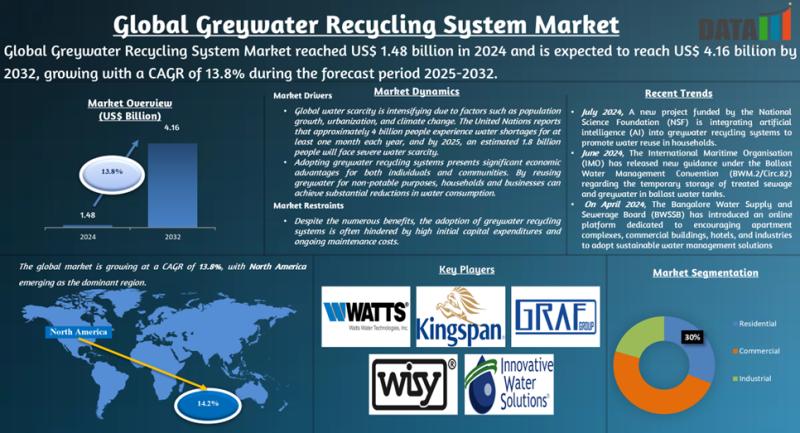
The Global Greywater Recycling System Market was valued at US$ 1.48 billion in 2024 and is projected to reach US$ 4.16 billion by 2032, expanding at a Compound Annual Growth Rate (CAGR) of 13.8% from 2025 to 2032. This growth is intrinsically linked to the global pursuit of the United Nations Sustainable Development Goals (SDGs), particularly those concerning water security, sustainable communities, and responsible consumption.
Contribution to Sustainable Development Goals (SDGs)
The expansion of the greywater recycling market is a direct response to global sustainability imperatives. These systems are critical infrastructure for achieving several key SDGs:
- SDG 6: Clean Water and Sanitation: By treating and reusing water from sources like showers, baths, and laundry, these systems reduce the demand on freshwater supplies and decrease the volume of wastewater requiring treatment, directly supporting targets for water-use efficiency and integrated water resources management.
- SDG 9: Industry, Innovation, and Infrastructure: The market is characterized by continuous innovation, including IoT connectivity, AI management, and advanced membrane filtration. These technological advancements build resilient and sustainable infrastructure, crucial for modern economies.
- SDG 11: Sustainable Cities and Communities: Greywater recycling is a cornerstone of sustainable urban development. Implementing these systems in residential and commercial buildings significantly reduces a city’s water footprint, making urban centers more resilient to water scarcity and environmental pressures.
- SDG 12: Responsible Consumption and Production: These systems embody the principles of a circular economy by promoting the sustainable management and efficient use of natural resources, specifically water. They encourage a shift away from a linear “use and dispose” model to a circular “use, treat, and reuse” approach.
Market Segmentation Analysis
By System Type
- Greywater Diversion System: This segment holds a dominant market share of approximately 60.7%. Its popularity stems from its cost-effectiveness and simplicity, offering an accessible solution for non-potable reuse (e.g., irrigation) that contributes directly to SDG 6 by reducing freshwater consumption.
- Greywater Treatment System: These systems utilize more advanced processes to achieve a higher quality of recycled water suitable for a wider range of applications. They represent a more intensive approach to achieving the water quality targets within SDG 6.
By Application
- Residential: Accounting for 47.5% of the market, this segment is driven by consumer awareness of water conservation. Residential adoption is a grassroots contribution to SDG 11 and SDG 12, embedding sustainable practices at the household level.
- Commercial and Industrial: These segments leverage greywater recycling to meet regulatory compliance, achieve corporate sustainability goals, and improve operational efficiency, aligning with SDG 9’s focus on sustainable industrialization.
Regional Insights and SDG Alignment
- North America: Leads the market with a 31.8% share, reflecting a mature infrastructure and established regulatory frameworks that support sustainable water management practices in line with SDG 6.
- Europe: As the fastest-growing region with a 26.1% share, its expansion is propelled by stringent environmental regulations and government policies aimed at tackling water scarcity, directly advancing the region’s commitment to the SDGs.
- Asia-Pacific: This region’s significant growth is driven by government initiatives to manage water constraints amid rapid urbanization. The adoption of greywater systems is a key strategy for building sustainable cities (SDG 11) and ensuring water availability (SDG 6).
Industry Developments and Innovations
Recent activities highlight the industry’s focus on technology and strategic growth to meet sustainability demands.
Technological Advancements
- November 2025: Hansgrohe and Hydraloop’s partnership introduced an advanced, IoT-enabled greywater recycling system, promoting smart and sustainable building solutions in alignment with SDG 9 and SDG 11.
- June 2025: A large-scale, AI-managed greywater recycling system implemented at a California tech campus reduced water consumption by 40%, demonstrating a scalable model for corporate water stewardship and smart city infrastructure (SDG 11).
- August 2025: Market growth was reported to be boosted by innovations in smart water monitoring and membrane filtration, driven by government sustainability policies across Europe, reinforcing the link between policy, innovation (SDG 9), and environmental goals (SDG 6).
Strategic Acquisitions
- May 2024: Coerco’s acquisition of Aquarius Wastewater Systems Pty Ltd. signifies a strategic consolidation to enhance wastewater and greywater treatment offerings, strengthening the industry’s capacity to deliver solutions that support SDG 6 across residential, commercial, and industrial sectors.
Key Market Players
Leading companies are advancing sustainable water management through innovative product development.
- Kingspan Group PLC
- Watts Water Technologies Inc.
- Graf Group
- WISY AG
- Innovative Water Solutions LLC
- Stormsaver Ltd
- Ecozi Ltd
- Molloy Precast Products Ltd.
- Aquaco Water Recycling Limited
- D&D Ecotech Services
Analysis of Sustainable Development Goals (SDGs) in the Article
1. Which SDGs are addressed or connected to the issues highlighted in the article?
-
SDG 6: Clean Water and Sanitation
The article’s primary focus is on greywater recycling systems, which are technologies designed to treat and reuse water from sources like showers, baths, and laundry. This directly addresses the goal of ensuring the availability and sustainable management of water and sanitation for all by promoting water reuse and conservation.
-
SDG 9: Industry, Innovation, and Infrastructure
The text highlights significant technological advancements and innovations in the greywater recycling market, such as IoT connectivity, AI management, and advanced membrane filtration. It discusses market growth, industry development, and the role of companies in creating sustainable infrastructure, which are central themes of SDG 9.
-
SDG 11: Sustainable Cities and Communities
The article mentions the application of these systems in residential and commercial buildings to promote “urban water sustainability” and create “smart building solutions.” By reducing water consumption in urban areas, these technologies help make cities more inclusive, safe, resilient, and sustainable.
-
SDG 12: Responsible Consumption and Production
Greywater recycling is a key practice for achieving sustainable management and efficient use of natural resources, specifically water. The article emphasizes water conservation and reuse, which aligns with the goal of ensuring sustainable consumption and production patterns by reducing resource use and waste generation.
2. What specific targets under those SDGs can be identified based on the article’s content?
-
Target 6.3: Improve water quality by increasing recycling and safe reuse.
The entire article is about the greywater recycling system market, which is a direct mechanism for achieving this target. It discusses various systems (diversion and treatment) and technologies (biological processes, membrane filtration) aimed at substantially increasing the recycling and reuse of water globally.
-
Target 6.4: Substantially increase water-use efficiency and address water scarcity.
The article notes that these systems are driven by “water scarcity concerns,” particularly in Europe. The example of a tech campus in California reducing its water consumption by 40% is a direct illustration of increasing water-use efficiency, which is the core of this target.
-
Target 9.4: Upgrade infrastructure and retrofit industries with clean and environmentally sound technologies.
The article describes the adoption of “advanced greywater recycling system[s]” with “IoT connectivity,” “AI-managed” systems, and “innovations in smart water monitoring.” These represent the adoption of clean and environmentally sound technologies to upgrade water management infrastructure in residential, commercial, and industrial sectors.
-
Target 11.6: Reduce the adverse per capita environmental impact of cities.
By implementing greywater recycling systems in “urban residential applications” and commercial buildings, cities can reduce their overall water consumption and wastewater generation. The article’s focus on “urban water sustainability” directly contributes to reducing the environmental footprint of cities.
-
Target 12.2: Achieve the sustainable management and efficient use of natural resources.
The growing market for greywater recycling systems, projected to reach US$ 4.16 billion by 2032, reflects a global trend towards the sustainable management and efficient use of water. The article highlights how residential and commercial users are adopting these systems for “water conservation” and “sustainable living practices.”
3. Are there any indicators mentioned or implied in the article that can be used to measure progress towards the identified targets?
- Percentage of water consumption reduction: The article explicitly states that a large-scale greywater recycling system in California led to a “40%” reduction in water consumption. This is a direct quantitative indicator for measuring progress in water-use efficiency (Target 6.4).
- Market growth and investment: The forecast that the Global Greywater Recycling System Market will grow from “US$ 1.48 billion in 2024” to “US$ 4.16 billion by 2032” with a “CAGR of 13.8%” serves as an indicator of the increasing adoption of water recycling technologies (Targets 6.3 and 9.4).
- Adoption rate by sector: The market segmentation data provides insights into the adoption of these systems. For instance, the residential segment holding “about 47.5% market share” indicates the level of adoption among households, which is relevant for measuring progress in sustainable consumption (Target 12.2) and reducing the environmental impact of cities (Target 11.6).
- Technological innovation and integration: The mention of specific technologies like “IoT-enabled” systems, “AI-managed” recycling, and “membrane filtration technologies” can be used as a qualitative indicator of the advancement and upgrading of infrastructure with clean technologies (Target 9.4).
4. Summary Table of SDGs, Targets, and Indicators
| SDGs | Targets | Indicators |
|---|---|---|
| SDG 6: Clean Water and Sanitation | 6.3: Improve water quality by increasing recycling and safe reuse. 6.4: Substantially increase water-use efficiency and address water scarcity. |
– Percentage reduction in water consumption (e.g., “40% reduction”). – Market size and growth of recycling systems (from $1.48B to $4.16B). |
| SDG 9: Industry, Innovation, and Infrastructure | 9.4: Upgrade infrastructure and retrofit industries with clean and environmentally sound technologies. | – Adoption of advanced technologies (IoT, AI, membrane filtration). – Industry collaborations for innovation (e.g., Hansgrohe and Hydraloop). |
| SDG 11: Sustainable Cities and Communities | 11.6: Reduce the adverse per capita environmental impact of cities. | – Implementation in “urban residential applications” and “smart building solutions.” – Regional market share in urbanized areas (e.g., North America, Europe). |
| SDG 12: Responsible Consumption and Production | 12.2: Achieve the sustainable management and efficient use of natural resources. | – Market share of residential systems (47.5%) reflecting consumer adoption. – Growth driven by “rising consumer awareness for water conservation.” |
Source: openpr.com
What is Your Reaction?
 Like
0
Like
0
 Dislike
0
Dislike
0
 Love
0
Love
0
 Funny
0
Funny
0
 Angry
0
Angry
0
 Sad
0
Sad
0
 Wow
0
Wow
0