
























































Air Pollution Control Systems Industry Research Report 2026 – GlobeNewswire
Global Air Pollution Control Systems Market Report 2026-2031
Market Overview and Sustainable Development Goals (SDGs) Alignment
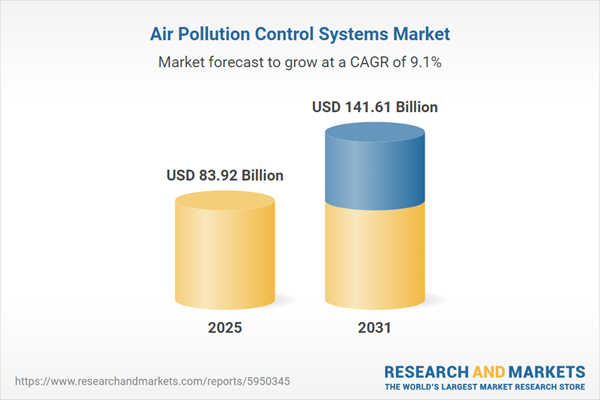
The Global Air Pollution Control Systems Market is projected to grow significantly, increasing from USD 83.92 billion in 2025 to USD 141.61 billion by 2031, at a compound annual growth rate (CAGR) of 9.11%. This growth supports several United Nations Sustainable Development Goals (SDGs), particularly SDG 3 (Good Health and Well-being), SDG 9 (Industry, Innovation, and Infrastructure), SDG 11 (Sustainable Cities and Communities), and SDG 13 (Climate Action).
The market includes industrial equipment such as thermal oxidizers, fabric filters, scrubbers, and electrostatic precipitators that reduce hazardous gaseous emissions and particulate matter from exhaust streams, directly contributing to improved air quality and public health.
Market Drivers with Emphasis on SDGs
- Stringent Environmental Regulations: Governments worldwide enforce strict emission standards to mitigate health risks from industrial pollution, aligning with SDG 3 and SDG 13 by promoting healthier environments and climate action.
- Rapid Industrialization in Emerging Economies: The expansion of infrastructure and energy sectors, especially thermal power, drives demand for pollution control technologies, supporting SDG 9 by fostering sustainable industrial innovation.
- Health Impact Awareness: Reports such as the European Environment Agency’s 2024 data reveal that 96% of the EU urban population is exposed to unsafe particulate matter levels, underscoring the urgency for pollution control aligned with SDG 11.
Market Challenges Affecting SDG Implementation
- High Capital and Operational Costs: The significant initial investment and ongoing expenses for installation and maintenance of pollution control systems pose barriers, especially for small and medium-sized enterprises (SMEs), potentially limiting progress toward SDG 9 and SDG 12 (Responsible Consumption and Production).
- Energy-Intensive Operations: The energy demands of high-efficiency filtration and scrubbing units may strain operational budgets and increase carbon footprints if not managed sustainably, impacting SDG 7 (Affordable and Clean Energy) and SDG 13.
- Financial Constraints on Compliance: Up to 10% of capital spending in European chemical companies is allocated to regulatory compliance, which can restrict investments in further environmental technologies, affecting SDG 8 (Decent Work and Economic Growth) and SDG 12.
Emerging Market Trends Supporting SDGs
- Integration with Carbon Capture Technologies: Combining air pollution control with carbon capture, utilization, and storage (CCUS) enhances emission management, advancing SDG 13 by reducing greenhouse gas emissions.
- Adoption of Artificial Intelligence and IoT: Smart sensors and predictive analytics optimize system performance and resource use, promoting SDG 9 and SDG 12 through innovation and sustainable industrial practices.
- Growth in Multi-Functional Emission Control: Facilities are evolving towards integrated systems that address multiple pollutants simultaneously, supporting comprehensive environmental management aligned with SDG 11 and SDG 13.
Key Market Players
- General Electric Company
- Siemens AG
- Honeywell International Inc.
- Mitsubishi Hitachi Power Systems, Ltd.
- Johnson Controls International PLC
- Babcock & Wilcox Enterprises, Inc.
- Thermax Limited
- CECO Environmental Corp
- Fujian Longking Co., Ltd.
- Ducon Technologies Inc.
Market Segmentation
By Product
- Scrubbers
- Thermal Oxidizers
- Catalytic Converters
- Electrostatic Precipitators
- Others
By Type
- Indoor
- Ambient
By Pollutant
- Gas
- Volatile Organic Compounds (VOC)
- Dust
- Others
By Application
- Tunnels
- Air Terminals
- Underground Garages
- Public Transportation Stations
- Air Pollution Control
- Automobile
- Others
By End User
- Powertrain Management
- Energy and Power
- Mining
- Agriculture
- Semiconductor
- Medical and Pharma
- Commercial and Residential
- Transportation
- Others
By Region
- North America
- Europe
- Asia-Pacific
- South America
- Middle East & Africa
Report Details
| Report Attribute | Details |
|---|---|
| Number of Pages | 185 |
| Forecast Period | 2025 – 2031 |
| Estimated Market Value (USD) in 2025 | $83.92 Billion |
| Forecasted Market Value (USD) by 2031 | $141.61 Billion |
| Compound Annual Growth Rate (CAGR) | 9.11% |
| Regions Covered | Global |
Conclusion
The growth of the Global Air Pollution Control Systems Market is integral to advancing multiple Sustainable Development Goals by reducing air pollution, promoting sustainable industrialization, and fostering innovation. Despite financial and operational challenges, ongoing technological integration and regulatory support are expected to drive market expansion and contribute to healthier, more sustainable communities worldwide.
For further information, please visit the ResearchAndMarkets.com report page.
1. Sustainable Development Goals (SDGs) Addressed or Connected
- SDG 3: Good Health and Well-being
- The article highlights the health risks associated with industrial air pollution and the need to reduce hazardous gaseous emissions and particulate matter, directly linking to SDG 3’s aim to reduce illnesses related to air pollution.
- SDG 7: Affordable and Clean Energy
- Discussion of thermal power projects and energy security in emerging economies relates to SDG 7, which promotes clean and sustainable energy solutions.
- SDG 9: Industry, Innovation, and Infrastructure
- The article covers industrial equipment innovation, integration of AI and IoT in pollution control systems, and infrastructure development, aligning with SDG 9.
- SDG 11: Sustainable Cities and Communities
- Exposure of urban populations to unsafe particulate matter levels and the need for pollution control in urban infrastructure connects to SDG 11.
- SDG 13: Climate Action
- The integration of carbon capture and storage technologies to reduce greenhouse gases supports SDG 13’s climate action goals.
- SDG 12: Responsible Consumption and Production
- Focus on regulatory compliance and sustainable industrial practices relates to SDG 12.
2. Specific Targets Under Those SDGs Identified
- SDG 3 – Target 3.9: Reduce the number of deaths and illnesses from hazardous chemicals and air, water, and soil pollution and contamination.
- Supported by efforts to reduce particulate matter exposure and hazardous emissions.
- SDG 7 – Target 7.2: Increase substantially the share of renewable energy in the global energy mix.
- Implied through the push for cleaner energy infrastructure and pollution control in thermal power plants.
- SDG 9 – Target 9.4: Upgrade infrastructure and retrofit industries to make them sustainable, with increased resource-use efficiency and greater adoption of clean and environmentally sound technologies.
- Reflected in the adoption of advanced air pollution control systems and integration of AI and IoT.
- SDG 11 – Target 11.6: Reduce the adverse per capita environmental impact of cities, including air quality.
- Addressed by reducing urban exposure to unsafe particulate matter levels.
- SDG 13 – Target 13.2: Integrate climate change measures into national policies, strategies, and planning.
- Supported by the integration of carbon capture and storage technologies in industrial emissions management.
- SDG 12 – Target 12.4: Achieve the environmentally sound management of chemicals and all wastes throughout their life cycle.
- Implied through regulatory compliance and pollution control technology adoption.
3. Indicators Mentioned or Implied to Measure Progress
- Indicator for SDG 3.9:
- Percentage of urban population exposed to air pollution levels exceeding WHO guidelines (e.g., 96% of EU urban population exposed to unsafe fine particulate matter in 2024).
- Indicator for SDG 7.2:
- Capacity of clean energy projects and adoption rate of pollution control systems in thermal power plants (e.g., 70 GW new coal power capacity with pollution control in China).
- Indicator for SDG 9.4:
- Number and value of industrial retrofitting projects with advanced pollution control technologies (e.g., INR 11,000 Crore order for thermal power emission control).
- Adoption rate of AI and IoT technologies in pollution control systems (e.g., 83% manufacturers planning AI deployment).
- Indicator for SDG 11.6:
- Levels of particulate matter (PM2.5) in urban areas and compliance with tightened standards (e.g., US EPA tightening PM2.5 standard from 12.0 to 9.0 µg/m³).
- Indicator for SDG 13.2:
- Increase in CO2 capture capacity of CCS projects (e.g., 60% increase in CO2 capture capacity in development pipeline).
- Indicator for SDG 12.4:
- Percentage of industrial capital expenditure dedicated to regulatory compliance (e.g., up to 10% in chemical companies in Europe).
4. Table: SDGs, Targets and Indicators
| SDGs | Targets | Indicators |
|---|---|---|
| SDG 3: Good Health and Well-being | Target 3.9: Reduce deaths and illnesses from hazardous chemicals and pollution | Percentage of urban population exposed to unsafe air pollution levels (e.g., 96% EU urban population exposed to unsafe PM levels) |
| SDG 7: Affordable and Clean Energy | Target 7.2: Increase share of renewable energy in global energy mix | Capacity of clean energy projects and adoption of pollution control in thermal power (e.g., 70 GW new coal power capacity with pollution control in China) |
| SDG 9: Industry, Innovation, and Infrastructure | Target 9.4: Upgrade infrastructure and retrofit industries for sustainability | Value and number of retrofitting projects (e.g., INR 11,000 Crore order for emission control); Adoption rate of AI and IoT in pollution control (e.g., 83% manufacturers planning AI deployment) |
| SDG 11: Sustainable Cities and Communities | Target 11.6: Reduce adverse environmental impact of cities including air quality | Levels of PM2.5 in urban areas and compliance with standards (e.g., US EPA tightening PM2.5 standard from 12.0 to 9.0 µg/m³) |
| SDG 13: Climate Action | Target 13.2: Integrate climate change measures into policies and planning | Increase in CO2 capture capacity of CCS projects (e.g., 60% increase in development pipeline) |
| SDG 12: Responsible Consumption and Production | Target 12.4: Environmentally sound management of chemicals and wastes | Percentage of industrial capital expenditure on regulatory compliance (e.g., up to 10% in European chemical companies) |
Source: globenewswire.com
What is Your Reaction?
 Like
0
Like
0
 Dislike
0
Dislike
0
 Love
0
Love
0
 Funny
0
Funny
0
 Angry
0
Angry
0
 Sad
0
Sad
0
 Wow
0
Wow
0