


























































Most Americans say government has a responsibility to ensure health care coverage – Pew Research Center
Report on Public Opinion Regarding Federal Government Responsibility for Health Care Coverage in the United States
Overview
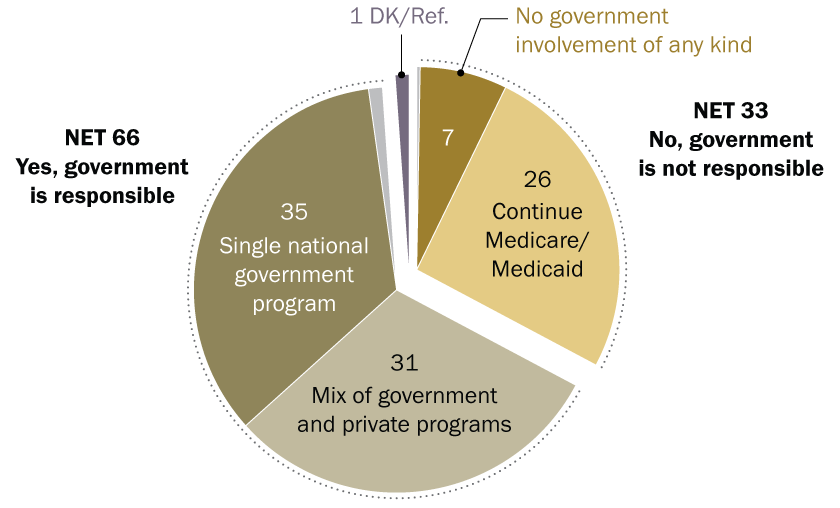
A recent survey conducted by the Pew Research Center from November 17 to 30, 2025, involving 10,357 U.S. adults, reveals that a majority of Americans (66%) believe the federal government has a responsibility to ensure health care coverage for all citizens. This public opinion aligns closely with the objectives of the United Nations Sustainable Development Goal (SDG) 3: Good Health and Well-being, which emphasizes universal health coverage and access to quality health care services.
Public Opinion on Government Responsibility
- Support for Government Responsibility: 66% of U.S. adults affirm that the federal government should ensure health care coverage for all Americans.
- Opposition to Government Responsibility: 33% of respondents believe the government should not have this responsibility.
Preferred Methods for Ensuring Health Coverage
Among those who support government responsibility, opinions differ on the approach:
- 35% favor a single national health insurance system managed by the government.
- 31% prefer a mixed system involving both private companies and government programs.
Conversely, among those who oppose government responsibility for universal coverage:
- 26% support continuing Medicare and Medicaid programs for seniors and low-income individuals.
- 7% advocate for no government involvement in health insurance provision.
Demographic Variations in Views
Political Affiliation
- Republicans and Republican-leaning Independents: 59% say the federal government is not responsible for ensuring health coverage for all, while 41% believe it is. This represents a 9 percentage point increase in support for government responsibility since 2021.
- Democrats and Democratic-leaning Independents: 90% affirm government responsibility, with 52% supporting a single national insurance program and 37% favoring the current mixed system. Only 10% oppose government responsibility.
Income Levels
- Majorities across all income groups support government responsibility, with stronger support among lower-income adults (77%) compared to middle (62%) and upper-income groups (61%).
- Among Republicans, lower-income individuals are significantly more likely (60%) to support government responsibility than middle-income (36%) and upper-income Republicans (28%).
- Democrats show overwhelming support across all income levels, with minor variations in preference for a single national program.
Other Demographic Factors
- Race and Ethnicity: Support for government responsibility is highest among Black (85%), Asian (78%), and Hispanic (75%) adults, compared to White adults (59%).
- Age: Younger adults (18-29 years) show higher support (74%) than older age groups.
- Education: Postgraduate degree holders show 70% support, with slight variations among other education levels.
Alignment with Sustainable Development Goals (SDGs)
The findings underscore the public’s endorsement of policies that resonate with the SDGs, particularly:
- SDG 3: Good Health and Well-being – Emphasizing universal health coverage and access to quality health services.
- SDG 10: Reduced Inequalities – Highlighting the importance of equitable health care access across income, racial, and ethnic groups.
- SDG 16: Peace, Justice, and Strong Institutions – Reflecting trust in government institutions to provide essential services.
Methodology
The survey was conducted using the American Trends Panel (ATP), a nationally representative panel recruited through random sampling of residential addresses. Interviews were conducted online or via telephone with live interviewers. The data were weighted to reflect the U.S. adult population by gender, race, ethnicity, partisan affiliation, education, and other factors.
For detailed methodology and questionnaire, refer to the American Trends Panel methodology.
Conclusion
The majority of Americans support federal government responsibility in ensuring health care coverage, with diverse preferences on implementation methods. These perspectives reflect a societal commitment to achieving universal health coverage, a core component of the Sustainable Development Goals. Policymakers may consider these public opinions to advance health equity and well-being in alignment with global development agendas.
1. Which SDGs are addressed or connected to the issues highlighted in the article?
- SDG 3: Good Health and Well-being
- The article focuses on health care coverage in the United States, which directly relates to ensuring healthy lives and promoting well-being for all at all ages.
- SDG 10: Reduced Inequalities
- The article discusses disparities in opinions on government responsibility for health care coverage across income levels, political affiliations, and demographic groups, highlighting issues of inequality in access to health care.
2. What specific targets under those SDGs can be identified based on the article’s content?
- Under SDG 3: Good Health and Well-being
- Target 3.8: Achieve universal health coverage, including financial risk protection, access to quality essential health-care services, and access to safe, effective, quality, and affordable essential medicines and vaccines for all.
- Under SDG 10: Reduced Inequalities
- Target 10.2: Empower and promote the social, economic and political inclusion of all, irrespective of age, sex, disability, race, ethnicity, origin, religion or economic or other status.
- The article’s focus on differences in views by income, race, ethnicity, and political affiliation relates to this target.
3. Are there any indicators mentioned or implied in the article that can be used to measure progress towards the identified targets?
- Indicators related to SDG 3.8 (Universal Health Coverage)
- Percentage of population covered by health insurance or a public health system.
- Public opinion metrics on government responsibility for ensuring health care coverage, as measured by the Pew Research Center survey (e.g., 66% of U.S. adults say government has responsibility).
- Indicators related to SDG 10.2 (Inclusion and Equality)
- Disaggregation of health coverage responsibility opinions by income level, race, ethnicity, age, and political affiliation.
- Differences in support for types of health coverage systems (single national program, mix of private and government programs, continuation of Medicare/Medicaid) across demographic groups.
4. Table of SDGs, Targets and Indicators
| SDGs | Targets | Indicators |
|---|---|---|
| SDG 3: Good Health and Well-being | Target 3.8: Achieve universal health coverage, including financial risk protection and access to quality essential health-care services. |
|
| SDG 10: Reduced Inequalities | Target 10.2: Empower and promote social, economic and political inclusion of all, irrespective of economic or other status. |
|
Source: pewresearch.org
What is Your Reaction?
 Like
0
Like
0
 Dislike
0
Dislike
0
 Love
0
Love
0
 Funny
0
Funny
0
 Angry
0
Angry
0
 Sad
0
Sad
0
 Wow
0
Wow
0