
























































Powering Rural Futures: Purdue’s Agrivoltaics Initiative for Sustainable Growth – Purdue University
Report on Midwest Agrivoltaics for Resilient Communities Initiative
Introduction
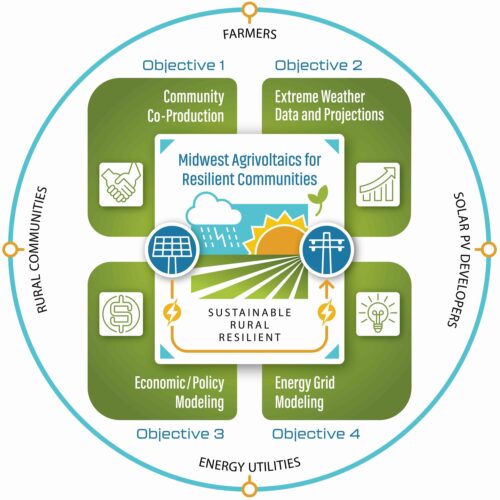
The National Science Foundation (NSF) has funded a pioneering project at Purdue University aimed at enhancing the resilience of rural Midwestern communities against extreme weather events such as hailstorms, heat waves, and high winds. The initiative, known as the Regional Resilience Innovation Incubator (R2I2): Midwest Agrivoltaics for Resilient Communities (MARC), is supported under grant #2519425. This project aligns closely with the United Nations Sustainable Development Goals (SDGs), particularly SDG 7 (Affordable and Clean Energy), SDG 11 (Sustainable Cities and Communities), SDG 13 (Climate Action), and SDG 15 (Life on Land).
Project Overview and Objectives
Agrivoltaics, the dual use of land for agriculture and solar energy production, is central to this initiative. It offers a promising solution to diversify farm income, reduce power outages, and increase energy production amid rising demand. Despite its potential, agrivoltaics adoption in the Midwest has been slow due to concerns about land use trade-offs, economic viability, and performance under extreme weather. The MARC incubator seeks to address these challenges by engaging community members, stakeholders, and experts to develop trusted information and strategies.
Key Sustainable Development Goals Addressed
- SDG 7: Affordable and Clean Energy – Promoting solar energy integration with agriculture to increase clean energy production.
- SDG 11: Sustainable Cities and Communities – Enhancing rural community resilience and prosperity through innovative energy solutions.
- SDG 13: Climate Action – Mitigating the impacts of extreme weather events on agriculture and energy infrastructure.
- SDG 15: Life on Land – Supporting sustainable land use that balances food production and energy generation.
Interdisciplinary Team and Leadership
The project is led by a multidisciplinary team of Purdue University experts spanning atmospheric science, agriculture, energy systems, economics, and social science. The team includes:
- Dr. Dan Chavas, Professor of Atmospheric Science, leading research on extreme weather risks.
- Dr. Aaron Thompson, Associate Professor of Horticulture and Landscape Architecture, focusing on sustainable landscape development and community engagement.
- Dr. Xiaonan Lu, Associate Professor in Engineering Technology and Electrical Engineering, leading resilience quantification and energy modeling.
- Dr. Kara Salazar, Community Development Specialist, co-leading community engagement and social science efforts.
- Dr. Juan Sesmero, Professor of Agricultural Economics, leading economic modeling and impact assessment.
Project Activities and Deliverables
- Building Trust & Community Engagement: Collaborating with local communities, agricultural, and energy partners to co-design agrivoltaics deployment strategies.
- Quantifying Extreme Weather Resilience Benefits: Assessing the impacts of hail, heat, and wind on agriculture and power grids, and evaluating agrivoltaics’ potential to mitigate these effects.
- Economic and Power Grid Models & Community Tools: Developing decision-support tools, metrics, and models tailored to local conditions to aid stakeholders in informed decision-making.
- Identifying Agrivoltaics Pathways: Determining optimal agrivoltaic configurations based on land, climate, and economic variables.
- Roadmap & Policy Framework: Creating a dynamic roadmap and policy framework to facilitate widespread, community-supported agrivoltaics adoption.
Expected Outcomes
By the conclusion of the initial funding phase, the project aims to deliver:
- Viable agrivoltaics models and pathways customized for diverse Midwestern geographies and farming systems.
- Decision-support tools for landowners, communities, and policymakers to evaluate risks and benefits.
- Strengthened partnerships among academia, industry, government, and local communities to foster sustainable development.
Alignment with Sustainable Development Goals
This initiative exemplifies a holistic approach to sustainable development by integrating clean energy production with agricultural resilience, thereby addressing multiple SDGs:
- SDG 7: Facilitates access to affordable, reliable, and modern energy through solar power.
- SDG 11: Supports sustainable rural communities by enhancing economic and environmental resilience.
- SDG 13: Contributes to climate adaptation by reducing vulnerability to extreme weather events.
- SDG 15: Promotes sustainable land use practices that protect ecosystems while supporting livelihoods.
Conclusion
The Midwest Agrivoltaics for Resilient Communities project represents a significant step toward sustainable rural development by leveraging innovative agrivoltaics technology. Through interdisciplinary collaboration and community engagement, the initiative aims to create resilient, prosperous rural communities aligned with global Sustainable Development Goals.
Further Information
For more details on the NSF Regional Resilience Innovation Incubator and the Midwest Agrivoltaics project, please visit the official project website.
Original article: Purdue Leads NSF-Funded Midwest Agrivoltaics Incubator to Boost Rural Energy and Economic Resilience to Extreme Weather
1. Sustainable Development Goals (SDGs) Addressed or Connected
- SDG 7: Affordable and Clean Energy
- The article discusses agrivoltaics, which combines agriculture with solar energy generation to increase energy production and reduce power outages in rural Midwest communities.
- SDG 11: Sustainable Cities and Communities
- The project aims to build resilience in rural communities against extreme weather events, enhancing their sustainability and prosperity.
- SDG 13: Climate Action
- The focus on resilience to extreme weather events such as hailstorms, heat waves, and high winds relates directly to climate change adaptation and mitigation.
- SDG 15: Life on Land
- The dual use of land for agriculture and solar energy supports sustainable land use and conservation efforts.
- SDG 8: Decent Work and Economic Growth
- The project supports diversification of farm income and economic resilience in rural communities.
2. Specific Targets Under Identified SDGs
- SDG 7: Affordable and Clean Energy
- Target 7.2: Increase substantially the share of renewable energy in the global energy mix.
- Target 7.3: Double the global rate of improvement in energy efficiency.
- SDG 11: Sustainable Cities and Communities
- Target 11.5: Reduce the number of deaths and the number of people affected by disasters, including water-related disasters, with a focus on protecting the poor and vulnerable.
- Target 11.B: Increase the number of cities and human settlements adopting and implementing integrated policies and plans towards inclusion, resource efficiency, mitigation and adaptation to climate change.
- SDG 13: Climate Action
- Target 13.1: Strengthen resilience and adaptive capacity to climate-related hazards and natural disasters in all countries.
- Target 13.3: Improve education, awareness-raising and human and institutional capacity on climate change mitigation, adaptation, impact reduction, and early warning.
- SDG 15: Life on Land
- Target 15.3: Combat desertification, restore degraded land and soil, including land affected by desertification, drought and floods.
- SDG 8: Decent Work and Economic Growth
- Target 8.3: Promote development-oriented policies that support productive activities, decent job creation, entrepreneurship, creativity and innovation.
- Target 8.4: Improve progressively, through 2030, global resource efficiency in consumption and production.
3. Indicators Mentioned or Implied to Measure Progress
- Energy Production and Efficiency Indicators
- Measurement of increased solar energy generation capacity through agrivoltaics systems.
- Reduction in power outages in rural communities.
- Resilience and Disaster Impact Indicators
- Quantification of how extreme weather events impact agriculture and power grids.
- Reduction in economic losses or damages caused by hailstorms, heat waves, and windstorms.
- Economic Indicators
- Economic modeling of agrivoltaics deployment to assess impacts on community resilience and farm income diversification.
- Adoption rates of agrivoltaics systems by farmers and communities.
- Community Engagement and Policy Indicators
- Number and effectiveness of community engagement activities and partnerships.
- Development and implementation of policy frameworks and roadmaps for agrivoltaics adoption.
4. Table: SDGs, Targets and Indicators
| SDGs | Targets | Indicators |
|---|---|---|
| SDG 7: Affordable and Clean Energy |
|
|
| SDG 11: Sustainable Cities and Communities |
|
|
| SDG 13: Climate Action |
|
|
| SDG 15: Life on Land |
|
|
| SDG 8: Decent Work and Economic Growth |
|
|
Source: purdue.edu
What is Your Reaction?
 Like
0
Like
0
 Dislike
0
Dislike
0
 Love
0
Love
0
 Funny
0
Funny
0
 Angry
0
Angry
0
 Sad
0
Sad
0
 Wow
0
Wow
0