




































Cabin Air Quality Management Systems Market | Global Industry Analysis & Outlook – 2036 – Fact.MR
Cabin Air Quality Management Systems Market Forecast and Outlook 2026 to 2036
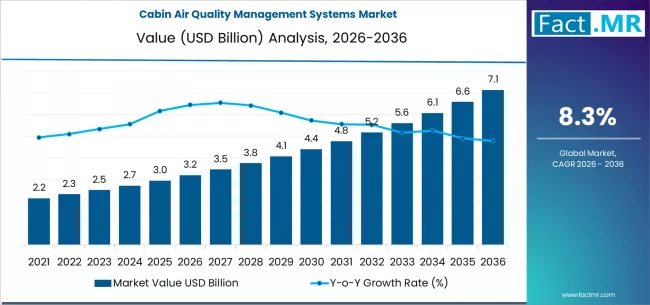
The global cabin air quality management systems market is projected to grow from USD 3.21 billion in 2026 to USD 6.42 billion by 2036, reflecting a compound annual growth rate (CAGR) of 8.3% over the forecast period. This growth aligns with Sustainable Development Goals (SDGs) such as SDG 3 (Good Health and Well-being) and SDG 11 (Sustainable Cities and Communities), emphasizing improved air quality and healthier living environments.
The HVAC integrated cabin air quality (CAQ) segment is expected to hold 52.9% of the market share in 2026, highlighting the importance of integrated systems in enhancing air quality management within vehicle cabins.
Key Market Highlights
- Market Value (2026): USD 3.21 billion
- Forecast Market Value (2036): USD 6.42 billion
- Forecast CAGR: 8.3%
- Leading Device Category: HVAC Integrated CAQ (52.9%)
- Key Growth Regions: North America, Europe, Asia Pacific
- Major Players: Denso, Bosch, Valeo, Mahle, MANN+HUMMEL
Market Overview and Sustainable Development Goals Integration
HVAC integrated control systems enable vehicle manufacturers to provide enhanced air quality control and pollutant management with improved operational efficiency. These systems contribute to SDG 9 (Industry, Innovation, and Infrastructure) by promoting advanced technological integration and SDG 13 (Climate Action) by reducing harmful emissions inside vehicle cabins.
Passenger vehicles are projected to represent 64.4% of the market in 2026, reflecting their critical role in advancing occupant health and regulatory compliance, supporting SDG 3 and SDG 12 (Responsible Consumption and Production).
Market Metrics
| Metric | Value |
|---|---|
| Estimated Value (2026E) | USD 3.21 billion |
| Forecast Value (2036F) | USD 6.42 billion |
| Forecast CAGR (2026-2036) | 8.3% |
Market Segmentation
By Vehicle Type
- Passenger Vehicles
- Light Commercial Vehicles (LCV)
- Premium or Luxury Vehicles
- Other Vehicle Types
By System Scope
- HVAC Integrated CAQ
- Sensor + Control Suites
- Filter + Ionizer Systems
- Other Systems
By Target Pollutants
- PM2.5 (Particulate Matter)
- Volatile Organic Compounds (VOCs)
- CO2 (Carbon Dioxide)
- Other Pollutants
By Sales Channel
- OEM Line-Fit
- Tier-1 Integrated Modules
- Aftermarket
- Other Channels
By Region
- North America (U.S., Canada, Mexico)
- Europe (Germany, UK, France, Italy, Spain, Nordic Countries, BENELUX, Rest of Europe)
- Asia Pacific (China, Japan, South Korea, India, Australia, Rest of Asia Pacific)
- Latin America (Brazil, Argentina, Rest of Latin America)
- Middle East and Africa (Saudi Arabia, UAE, South Africa, Rest of MEA)
- Other Regions (Oceania, Central Asia, Other Markets)
Segmental Analysis
System Scope Dominance
The HVAC integrated CAQ segment leads with a 52.9% market share, driven by:
- Manufacturing investments in advanced air quality control technologies.
- Prioritization of operational efficiency and performance validation by automotive professionals.
This supports SDG 9 by fostering innovation and infrastructure development in automotive air quality management.
Vehicle Segment Leadership
Passenger vehicles dominate with a 64.4% share, reflecting their importance in:
- Implementing advanced air quality control protocols.
- Supporting occupant health and regulatory compliance.
This aligns with SDG 3 and SDG 11 by promoting health and sustainable urban transport solutions.
Market Drivers, Restraints, and Trends
- Drivers: Increasing demand from vehicle manufacturers for enhanced air quality control and pollutant management.
- Restraints: High costs and technical complexity in integrating specialized air quality systems.
- Trend 1: Shift towards automated air quality configurations reducing operational requirements and costs.
- Trend 2: Development of multi-parameter compatible systems for diverse vehicle applications.
Regional Market Analysis and Sustainable Development Implications
China
Projected CAGR of 10.2% driven by rapid automotive infrastructure growth and regulatory support for vehicle efficiency and air quality technologies. This supports SDG 9 and SDG 13 by promoting sustainable industrialization and climate action.
- Growing demand for advanced air quality management in automotive markets.
- Strong regulatory frameworks encouraging adoption of premium air quality solutions.
Brazil
Expected CAGR of 10.0% due to rising automotive investments and infrastructure development, aligning with SDG 9 and SDG 11.
- Expansion of vehicle management technologies.
- Increasing operational awareness and technology adoption.
United States
Forecast CAGR of 7.8%, supported by emphasis on precision, vehicle excellence, and advanced technology integration, contributing to SDG 3 and SDG 9.
- Demand for specialized air quality control in performance applications.
- Focus on operational efficiency and cost reduction.
Germany
Projected CAGR of 7.6%, driven by technology excellence and system integration, supporting SDG 9 and SDG 12.
- Demand for precision air quality control services.
- Emphasis on operational control and analytical precision.
South Korea
Expected CAGR of 7.7%, with steady demand for premium air quality solutions, supporting SDG 3 and SDG 9.
- Established vehicle management markets.
- Strong quality standards and operational efficiency focus.
United Kingdom
Forecast CAGR of 7.5%, emphasizing technology excellence and operational control, aligned with SDG 9 and SDG 11.
- Growing demand for air quality control in specialty applications.
- Focus on analytical precision and technology adoption.
Japan
Projected CAGR of 6.9%, supported by advanced technology integration and operational control, contributing to SDG 9 and SDG 12.
- Demand for precision air quality management.
- Strong focus on technology excellence and operational objectives.
Competitive Landscape
The cabin air quality management systems market is competitive, with key players investing in advanced technologies and service networks to ensure high-quality and reliable solutions. This fosters innovation and sustainable industrial growth, supporting SDG 9.
- Denso
- Bosch
- Valeo
- Mahle
- MANN+HUMMEL
- Hanon Systems
- Panasonic
- Hyundai Mobis
- Continental
- Honeywell
Scope of the Report
| Item | Details |
|---|---|
| Quantitative Units (2026) | USD 3.21 Billion |
| Vehicle Types | Passenger Vehicles, LCV, Premium or Luxury, Other |
| System Scope | HVAC Integrated CAQ, Sensor + Control Suites, Filter + Ionizer Systems, Other |
| Target Pollutants | PM2.5, VOCs, CO2, Other |
| Sales Channels | OEM Line-Fit, Tier-1 Integrated Modules, Aftermarket, Other |
| Regions Covered | North America, Europe, Asia Pacific, Latin America, Middle East & Africa |
| Countries Covered | China, Brazil, U.S., Germany, South Korea, U.K., Japan, and others |
| Key Companies Profiled | Denso, Bosch, Valeo, Mahle, MANN+HUMMEL, and others |
| Additional Attributes | Revenue by vehicle, system scope, pollutants, sales channel, region; demand trends; competitive landscape; technological advancements; operational performance optimization; vehicle enhancement programs; premium air quality control development strategies |
Bibliography
- International Automotive Technology Association Research Committee. (2023). Air quality control technologies and performance optimization in automotive control systems. International Automotive Technology Association.
- International Organization for Standardization. (2023). Vehicle quality management: Assessment of air quality control technology, operational efficiency, and quality control of cabin air systems (ISO Technical Report). ISO.
- European Committee for Standardization. (2022). Vehicle quality management: Evaluation of air quality processing, quality control, and operational compliance in automotive facilities (EN Technical Report). CEN.
- Journal of Automotive Air Quality Editorial Board. (2024). Air quality processing, quality control, and performance optimization in modern automotive facilities. Journal of Automotive Air Quality, 150(4), 245-262.
- Automotive Technology Agency, Technical Committee. (2023). Advances in air quality processing and quality control technologies for automotive and transportation applications. Automotive Technology Agency.
1. Sustainable Development Goals (SDGs) Addressed or Connected
- SDG 3: Good Health and Well-being
- The article emphasizes improving cabin air quality to ensure occupant health environments, which aligns with SDG 3’s focus on reducing health risks from environmental pollution.
- SDG 9: Industry, Innovation, and Infrastructure
- Development and adoption of advanced cabin air quality management systems reflect innovation in automotive technology and infrastructure improvement.
- SDG 11: Sustainable Cities and Communities
- Improving air quality in vehicles contributes to healthier urban environments and sustainable transportation solutions.
- SDG 12: Responsible Consumption and Production
- Focus on efficient air quality control technologies and operational performance optimization supports sustainable production and consumption patterns.
- SDG 13: Climate Action
- Targeting pollutants such as CO2 and VOCs in vehicle cabins contributes indirectly to climate action by reducing emissions and improving environmental quality.
2. Specific Targets Under Identified SDGs
- SDG 3: Good Health and Well-being
- Target 3.9: Reduce the number of deaths and illnesses from hazardous chemicals and air, water, and soil pollution and contamination.
- SDG 9: Industry, Innovation, and Infrastructure
- Target 9.5: Enhance scientific research, upgrade the technological capabilities of industrial sectors, including automotive air quality control technologies.
- SDG 11: Sustainable Cities and Communities
- Target 11.6: Reduce the adverse per capita environmental impact of cities, including air quality improvements in transportation.
- SDG 12: Responsible Consumption and Production
- Target 12.2: Achieve sustainable management and efficient use of natural resources, reflected in efficient air quality control systems.
- SDG 13: Climate Action
- Target 13.2: Integrate climate change measures into national policies, strategies, and planning, including reducing vehicle emissions.
3. Indicators Mentioned or Implied to Measure Progress
- Market Growth Metrics
- Market valuation growth from USD 3.21 billion in 2026 to USD 6.42 billion in 2036 (CAGR 8.3%) indicates adoption rate and technological advancement.
- Pollutant Reduction Indicators
- Measurement of reductions in PM2.5, VOCs, and CO2 levels inside vehicle cabins as target pollutants.
- Adoption and Deployment Rates
- Percentage share of HVAC integrated CAQ systems (52.9%) and passenger vehicle applications (64.4%) reflect market penetration and technology uptake.
- Geographical Growth Rates
- CAGR by country (e.g., China 10.2%, Brazil 10.0%, U.S. 7.8%) indicating regional progress in air quality management system adoption.
- Operational Performance and Compliance
- Standards and regulatory adherence in vehicle air quality monitoring and operational control optimization as qualitative indicators.
4. SDGs, Targets and Indicators Table
| SDGs | Targets | Indicators |
|---|---|---|
| SDG 3: Good Health and Well-being | Target 3.9: Reduce deaths and illnesses from hazardous air pollution |
|
| SDG 9: Industry, Innovation, and Infrastructure | Target 9.5: Enhance technological capabilities in industrial sectors |
|
| SDG 11: Sustainable Cities and Communities | Target 11.6: Reduce environmental impact of cities including air pollution |
|
| SDG 12: Responsible Consumption and Production | Target 12.2: Sustainable management and efficient use of natural resources |
|
| SDG 13: Climate Action | Target 13.2: Integrate climate change measures into policies and planning |
|
Source: factmr.com
What is Your Reaction?
 Like
0
Like
0
 Dislike
0
Dislike
0
 Love
0
Love
0
 Funny
0
Funny
0
 Angry
0
Angry
0
 Sad
0
Sad
0
 Wow
0
Wow
0