Commission unveils transport package combining high-speed rail plan and new investment strategy for sustainable fuels
The European Commission has presented a comprehensive transport package centred on the High-Speed Rail Action Plan and the Sustainable Transport Investment Plan (STIP), described by Executive Vice-President Fitto as key to competitiveness and cohesion. Together, the measures aim to accelerate the completion of a connected European rail network by 2040 and to mobilise large-scale investment for renewable and low-carbon fuels in aviation and maritime transport.
Speaking in Brussels, Commissioner Tzitzikostas said the two initiatives are guided by the principles of competitiveness and sustainability. For rail, the goal is to expand Europe’s 12 000 km of high-speed infrastructure, currently concentrated in Spain, France, Italy and Germany, and to close cross-border gaps, particularly in Central and Eastern Europe. The Commission estimates that full network completion would cost €550 billion and yield €200 billion in additional social and economic benefits.
The plan sets a 2040 deadline for a truly European network, supported by a dedicated financing strategy, harmonised digital systems through the European Rail Traffic Management System (ERTMS), and new rules on ticketing and rolling stock certification. A proposal due in early 2026 will make cross-border booking “one click” and create a second-hand market for trainsets. The Commission also intends to review procurement rules to encourage standardised train design and faster production, while strengthening ERA’s role in vehicle authorisation and safety oversight.
STIP establishes a parallel investment framework for renewable and low-carbon fuels across all transport modes, with a focus on aviation and shipping where electrification is limited. To meet ReFuelEU Aviation and FuelEU Maritime targets, Europe must produce about 20 million tonnes of sustainable fuels annually by 2035. The Commission estimates €100 billion in required investment and plans to mobilise at least €2.9 billion from existing EU programmes including the Innovation Fund, Horizon Europe and InvestEU by 2027.
A pilot eSAF Early Movers Coalition will seek to attract €500 million for synthetic fuel projects, complemented by a mechanism to link producers with offtakers to provide revenue certainty. The Commission will also examine how the EU ETS can further support the aviation and maritime sectors and strengthen international partnerships to ensure fair competition for European producers.
According to Fitto, the measures will “make Europe more united and more efficient”, offering passengers faster connections and affordable alternatives to short-haul flights while creating a framework for private investment in clean transport fuels. Tzitzikostas added that implementation in the next two years will be decisive if the EU is to meet its 2030 and 2035 targets.
See also: STIP: Aviation Gains Structured Support as Maritime Is Left Treading Water
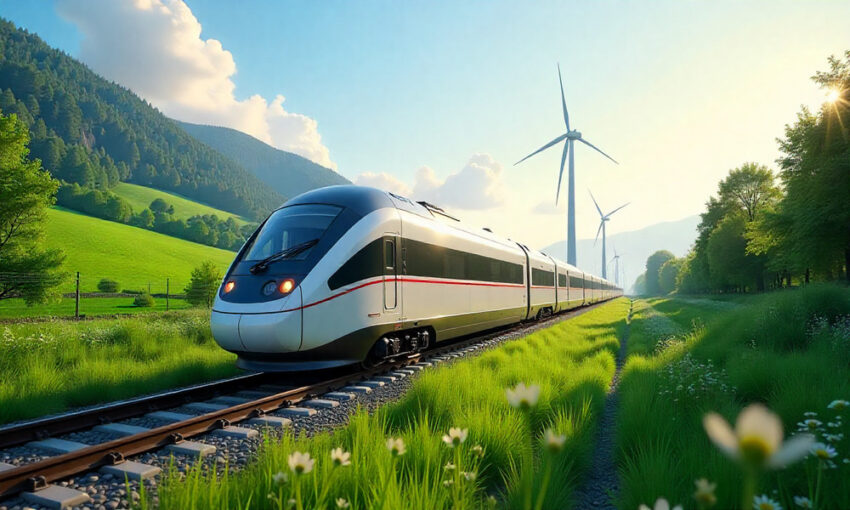
Commission sets 2040 blueprint for a connected European high-speed rail network: policy overview
The European Commission has set out a plan to complete a connected high-speed rail network by 2040, pairing corridor-level delivery timetables with a new financing approach and tighter EU-level coordination. The Communication, Connecting Europe through High Speed Rail (COM(2025) 903), argues that a continuous network linking capitals and major urban nodes can halve journey times on many cross-border routes, shift demand from short and medium haul aviation and private cars, and relieve pressure on metropolitan housing markets by widening labour catchments.
Brussels concedes that current performance is off track. Since 2015, high-speed rail traffic has risen by 17 per cent, and 12,128 km of high-speed lines are in operation, mostly in Spain, France, Italy and Germany. Central and eastern Europe remain fragmented. The plan therefore asks Member States and infrastructure managers to exceed the minimum 200 km/h TEN-T specification where viable and to design priority sections for very high speeds, including above 250 km/h, so that the core and extended core passenger network functions as one system.
Delivery is anchored in two governance moves. First, each European Transport Corridor will include a high-speed chapter in its work plan by mid-2026 that identifies national and cross-border bottlenecks and proposes fixes. Second, by 2027, the Commission will adopt corridor implementing decisions that set binding milestones for 2030, 2035 and 2040, covering scope, speeds, travel time targets and funding paths. A 2026 review of the Streamlining Directive will address permitting and procurement lag on complex, cross-border projects.
Financing is framed as the immediate constraint. Completing the currently planned TEN-T high-speed network by 2040 is estimated to cost about EUR 345 billion. Tripling today’s network and designing for very high speed would bring the bill to about EUR 546 billion, with a net positive benefit to society estimated at around EUR 750 billion and construction activity supporting more than 1.5 million job-years by 2050. The Commission will prioritise high-speed rail in a 2026 CEF call and proposes to double CEF Transport in 2028–2034 to EUR 51.5 billion, including an indicative EUR 17.7 billion for dual-use infrastructure. Cohesion instruments, InvestEU, Horizon Europe and EIB lending remain central. By end 2025 the Commission will table an EU financing strategy leading to a 2026 High Speed Rail Deal that aligns Member States, the EIB, national promotional banks, private investors and the rail supply chain around bankable project pipelines, blending grants, guarantees and user revenues, and standardising models such as PPPs, regulated asset base approaches and cross financing from road and ETS proceeds.
The market framework is tightened to make services viable and fares competitive. The proposed Capacity Management Regulation would hard-wire cross-border planning and digital traffic management, with multiannual capacity agreements to give operators path certainty. Guidance on track access charges and a recent Court of Justice ruling point toward tariff structures that maximise use of the network, including newcomer discounts and transparent market segmentation, subject to State aid rules. A 2026 ticketing package is planned to ease the purchase of multi-operator and multimodal journeys and to strengthen rail passenger rights where a single transaction covers several carriers. The Commission will also toughen the implementing rules on non-discriminatory access to service facilities, responding to uneven distribution of depots, stabling and station services that can lock out new entrants.
Rolling stock availability is treated as a strategic bottleneck. Brussels will work with the EIB, national promotional banks and private finance to expand leasing and guarantee tools for first movers, in line with State aid law. To spur a secondary market, the Commission will propose legislation in 2027 to curb anti-competitive scrapping and to set transparent cross-border conditions for resale and reuse. In parallel, authorisation and certification will be simplified. ERA’s role would be reinforced in 2026 so that high speed train approvals are valid at EU scale, cutting duplicated testing and shortening time to market. A reform of train driver certification is planned to create a single professional standard for operation across networks.
Interoperability is the backbone of the industrial chapter. The 2040 TEN-T obligation to replace national signalling with ERTMS is reaffirmed, with a new European deployment plan due in 2026 and stricter enforcement. Member States are asked to eliminate other technical divergences on high-speed lines and access routes, and to connect city approaches and diversionary lines so that long-distance, night and freight services can exploit released capacity. Recognising that costs for ERTMS products have risen under fragmented approaches, the Commission will push co-creation of a next generation of harmonised, multi-network high-speed trainsets under Europe’s Rail in 2026, paired with standardised infrastructure components to recover economies of scale, lift production capacity and shorten delivery timelines.
Resilience and environmental performance are carried through the asset life cycle. After extreme weather events repeatedly damaged key routes, the Commission will fund climate proofing and publish guidance this year for national noise action plans. By 2028 it wants harmonised life cycle assessment and climate resilience methodologies for transport infrastructure so that design choices reflect total environmental footprint and exposure to heat, floods and fires. Member States are encouraged to deploy on-site renewables and procure low-emission materials for construction and operation, and to specify the safety standards needed for integrated generation.
The plan seeks a stronger interconnection with other modes. The Commission will analyse rail connectivity at 40 major airports and promote best practice for urban hubs that link high-speed rail with local public transport, cycling and shared mobility. The wider network gains are explicit. Separating fast intercity and high-speed flows from the classic network should unlock capacity for regional and freight services, including movements relevant for military mobility, and accelerate night train development where track access, facilities and authorisations are coordinated.
Monitoring is designed to keep pressure on delivery. From 2026, a scoreboard will track kilometres of high-speed line, average speeds, passenger volumes and ERTMS roll-out, supported by an annual survey on perceived progress. Where specific cross-border city pairs face persistent barriers, the Commission will convene targeted roundtables on technical interfaces, facilities and charging. The expectation is that fixed milestones, standardised technology, predictable access to paths and capital, and a workable secondary market for trains together will convert latent demand into an affordable pan-European high-speed offer by 2040.
Aviation industry calls for stronger incentives and clearer timelines following EU’s Sustainable Transport Investment Plan
Aviation stakeholders have broadly welcomed the European Commission’s Sustainable Transport Investment Plan (STIP) as a step towards addressing the financing and policy barriers facing the industry’s transition to net zero, while warning that the measures fall short of what is needed to scale up sustainable aviation fuel (SAF) production and ensure Europe’s competitiveness.
The DESTINATION 2050 alliance, which includes A4E, ACI EUROPE, ASD, CANSO Europe and ERA, described STIP as a constructive step that finally recognises the investment challenge and begins to consolidate EU financing instruments for SAF projects. The group welcomed the plan’s reference to a double-sided auction system designed to reduce the cost gap between fossil fuels and SAF, but said the proposed EU funding envelope remains “disappointingly low” compared with the estimated €100 billion required by 2035.
Industry groups also voiced concern that key elements of the investment and regulatory framework remain undefined. The lack of a concrete timetable for introducing a Book & Claim mechanism, which would allow airlines to access SAF credits regardless of local availability, is viewed as a critical omission. The alliance urged the Commission to prioritise its design and implementation, alongside a post-2030 extension of SAF allowances under the EU ETS and the use of ETS revenues to support fuel production.
The European Express Association (EEA) called the STIP “a small step in the right direction” but said €3.5 billion of support is “a drop in the ocean” compared with investment needs. The association reiterated the sector’s demand for a credible Book & Claim system and for longer-term, scaled-up SAF incentives to underpin multi-year offtake agreements.
From the perspective of emerging fuel producers, the Skies and Seas Hydrogen-fuels Accelerator (SASHA) Coalition welcomed the inclusion of auction mechanisms and risk-reduction tools for e-fuels but criticised the limited focus on zero-emission technologies. SASHA Director of EU Policy Aurelia Leeuw said the Commission “deserves credit for de-risking e-fuel production” but warned that the plan lacks ambition on ETS reform and fails to secure sufficient backing for hydrogen and electric propulsion. She also cautioned that without a clear focus on e-kerosene produced within the European Economic Area, the planned Book & Claim system risks weakening Europe’s competitive edge.
Aviation stakeholders are now calling for coordinated follow-up between the Commission, Member States and industry to ensure policy coherence and stable investment conditions. Several groups have joined the Commission’s call for the European Investment Bank to increase its involvement in SAF financing and for unused national Recovery and Resilience funds to be redirected to low-carbon fuel projects before mid-2026.
Maritime sector urges rapid follow-up and market measures to make clean fuels competitive under STIP
Maritime industry groups have welcomed the European Commission’s Sustainable Transport Investment Plan (STIP) as an important step towards scaling renewable and low-carbon fuels, while urging faster follow-up and clearer measures to close the price gap between clean and conventional fuels.
European shipowners described the plan as a “good first step” that identifies the right investment priorities but warned that immediate action is needed to turn its commitments into practice. ECSA Secretary General Sotiris Raptis said that while Europe has “ambitious climate targets,” it still lacks the clean fuels necessary to achieve them. He called for revenues from the EU Emissions Trading System (ETS), estimated at €9 billion from the shipping sector, to be used to make renewable fuels more affordable and to support a binding mandate for European suppliers to provide clean fuels for shipping. ECSA also welcomed the Commission’s commitment to simplify reporting requirements for shipping companies, particularly for SMEs, and urged full alignment between EU and future International Maritime Organization measures to maintain a global level playing field.
Cruise Lines International Association (CLIA) similarly praised the plan for sending “a strong signal of support for scaling up renewable and low-carbon fuels.” The organisation highlighted that 97 percent of the world’s cruise ships are built in European shipyards, with €57 billion in new ship investments planned between 2024 and 2036. CLIA noted that Europe’s shipyards and supply chains can play a pivotal role in producing renewable fuels and technologies if the right policy and financial instruments are in place.
SEA-LNG welcomed the plan’s explicit recognition of the “methane decarbonisation pathway,” including LNG, biomethane and e-methane. The group said this confirms the inclusion of methane-based fuels in the EU’s clean-fuel mix and aligns with current market trends, with over 70 percent of alternative-fuel vessel tonnage ordered in 2025 designed for methane use. SEA-LNG called for consistent funding and eligibility frameworks for renewable methane and for existing LNG infrastructure to be treated as a foundation for future e-methane distribution.
The World Shipping Council (WSC) called the STIP “a promising first step” but stressed that it must now translate into financial mechanisms that make renewable marine fuels competitive. WSC said the maritime sector alone could absorb 14.4 million tonnes of renewable fuels by 2035; around 70 per cent of the Commission’s combined target for aviation and shipping, if investment conditions are right. The group urged the EU to focus STIP funding on price-bridging measures, targeted incentives for renewable fuels, and risk-sharing tools linking producers and buyers.




























































 Like
0
Like
0
 Dislike
0
Dislike
0
 Love
0
Love
0
 Funny
0
Funny
0
 Angry
0
Angry
0
 Sad
0
Sad
0
 Wow
0
Wow
0