






























Advanced economy leadership is key to the low-carbon transition – Oxford Economics
Report on the Role of Advanced Economies in the Global Low-Carbon Transition and Sustainable Development
Executive Summary
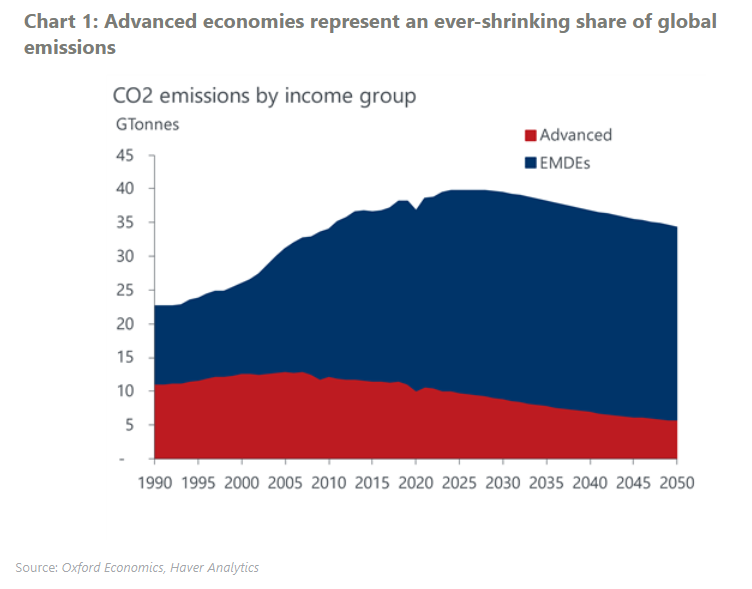
This report analyzes the critical role of Advanced Economies (AEs) in facilitating a global low-carbon transition, with a direct focus on achieving the United Nations Sustainable Development Goals (SDGs). Projections indicate that Emerging Market and Developing Economies (EMDEs) will contribute 70% of global CO₂ emissions between 2000-2050, making their accelerated transition essential for meeting the objectives of SDG 13 (Climate Action). A simulation using the Oxford Economics’ Global Economic Model demonstrates that proactive leadership from AEs—through innovation, financial support, and technology transfer—can limit global warming to 1.8°C. This collaborative approach not only advances SDG 7 (Affordable and Clean Energy) and SDG 9 (Industry, Innovation, and Infrastructure) in EMDEs but also yields a 0.2% increase in global GDP by 2050, contributing to SDG 8 (Decent Work and Economic Growth). The primary challenge lies in strengthening SDG 17 (Partnerships for the Goals) to overcome political and implementation barriers.
The Imperative for Global Climate Action: An SDG Perspective
The Critical Role of Emerging Economies in Achieving SDG 13
The successful implementation of SDG 13 (Climate Action) is fundamentally dependent on a global reduction in carbon emissions. A significant challenge arises from the developmental trajectory of EMDEs, which are projected to be the primary source of future emissions.
- Emission Contribution: EMDEs are forecasted to account for 70% of cumulative global CO₂ emissions from 2000 to 2050.
- Transition Gaps: Current gaps in AE leadership, including policy inconsistencies and insufficient climate finance, jeopardize the global timeline for emissions reduction and risk slowing the transition in these critical economies.
A Modeled Pathway to Achieving Climate and Development Goals
A scenario modeled by Oxford Economics outlines a pathway where AE leadership accelerates the global transition, leading to positive outcomes across multiple SDGs.
Advanced Economy Leadership as a Catalyst for SDG 7 and SDG 9
AE leadership in technology and finance is paramount for fostering sustainable development in EMDEs, directly supporting the targets of SDG 7 and SDG 9.
- Innovation and Technology Costs: By driving innovation, AEs can significantly lower the costs of low-carbon technologies, making them accessible and affordable for EMDEs, thereby advancing SDG 7 (Affordable and Clean Energy).
- Financial Support for Infrastructure: Providing robust financial support enables EMDEs to invest in resilient and sustainable infrastructure, a core component of SDG 9 (Industry, Innovation, and Infrastructure).
Economic Co-benefits and Progress Towards SDG 8
The modeled scenario indicates that an accelerated low-carbon transition generates significant economic benefits, aligning with the principles of SDG 8 (Decent Work and Economic Growth).
- Global GDP Growth: By avoiding the most severe climate damages, the global transition pathway is projected to raise global GDP by 0.2% above the baseline by 2050.
- Sustainable Growth: This outcome underscores that climate action and sustainable economic development are mutually reinforcing goals.
Challenges and Recommendations for SDG 17: Partnerships for the Goals
Achieving this accelerated transition requires a profound strengthening of global partnerships, as outlined in SDG 17. Scaling up climate finance is not merely aid but a strategic investment in global stability and prosperity, which is in the direct interest of AEs.
Key Barriers to Progress
- Political barriers within AEs that hinder the allocation of sufficient climate finance.
- Lagging policy implementation and institutional capacity within EMDEs.
Strategic Recommendations for Effective Support
- Early and Large-Scale Funding: Mobilize substantial financial resources at the outset to catalyze the transition in EMDEs.
- Capacity Building: Strengthen institutional and technical capabilities within EMDEs to ensure the effective deployment of funds and implementation of climate policies.
- Sustained Ambition: AEs must maintain or increase their own climate ambitions to lead by example and drive down technology costs for the global community.
Analysis of SDGs, Targets, and Indicators
1. Which SDGs are addressed or connected to the issues highlighted in the article?
The article on the low-carbon transition, led by advanced economies, addresses several interconnected Sustainable Development Goals. The analysis identifies the following SDGs as being directly relevant to the core themes of climate change mitigation, international cooperation, finance, and technological innovation discussed in the text:
- SDG 7: Affordable and Clean Energy: The fundamental concept of a “low-carbon transition” inherently involves shifting away from fossil fuels towards cleaner and more sustainable energy sources.
- SDG 8: Decent Work and Economic Growth: The article connects the low-carbon transition to economic outcomes, stating that the simulated scenario would raise “global GDP by 0.2% above baseline by 2050 through avoided climate damages.” This links climate action to sustainable economic growth.
- SDG 9: Industry, Innovation, and Infrastructure: The role of advanced economies in “driving innovation” and “lowering technology costs” is a central point, directly aligning with the goal of fostering innovation and promoting sustainable industrialization.
- SDG 13: Climate Action: This is the primary SDG addressed. The entire article focuses on strategies to accelerate emissions reductions, limit global warming, and scale up climate finance, which are core components of climate action.
- SDG 17: Partnerships for the Goals: The article’s main premise is the partnership between advanced economies (AEs) and emerging market and developing economies (EMDEs). It emphasizes the need for financial support, technology transfer, and capacity building to achieve a global transition.
2. What specific targets under those SDGs can be identified based on the article’s content?
Based on the specific actions and outcomes described in the article, the following targets can be identified:
- Under SDG 7 (Affordable and Clean Energy):
- Target 7.a: Enhance international cooperation to facilitate access to clean energy research and technology… and promote investment in energy infrastructure and clean energy technology. This is directly supported by the article’s call for AEs to provide “financial support to EMDEs” and lead by “driving innovation, lowering technology costs.”
- Under SDG 9 (Industry, Innovation and Infrastructure):
- Target 9.4: Upgrade infrastructure and retrofit industries to make them sustainable, with increased resource-use efficiency and greater adoption of clean and environmentally sound technologies. The “low-carbon transition” described is a direct implementation of this target.
- Target 9.b: Support domestic technology development, research and innovation in developing countries. This is reflected in the scenario where AE leadership “enables EMDEs to accelerate their transition.”
- Under SDG 13 (Climate Action):
- Target 13.2: Integrate climate change measures into national policies, strategies and planning. The article points to this need by mentioning challenges like “US policy rollbacks” and “lagging EMDE policy implementation,” while calling for “sustained or increased AE climate ambition.”
- Target 13.a: Implement the commitment undertaken by developed-country parties… to mobilize financial resources to address the needs of developing countries. The article directly addresses this by highlighting “insufficient climate finance” as a risk and calling to “scale up climate finance to EMDEs.”
- Target 13.b: Promote mechanisms for raising capacity for effective climate change-related planning and management in developing countries. This is explicitly mentioned as the need for “strengthened institutional and technical capacity in EMDEs.”
- Under SDG 17 (Partnerships for the Goals):
- Target 17.3: Mobilize additional financial resources for developing countries from multiple sources. The call to “scale up climate finance to EMDEs” is a direct reference to this target.
- Target 17.7: Promote the development, transfer, dissemination and diffusion of environmentally sound technologies to developing countries. This is a core part of the proposed solution, where AEs lead by “driving innovation” and “lowering technology costs” for the benefit of EMDEs.
- Target 17.9: Enhance international support for implementing effective and targeted capacity-building in developing countries. This aligns with the recommendation for “strengthened institutional and technical capacity in EMDEs.”
3. Are there any indicators mentioned or implied in the article that can be used to measure progress towards the identified targets?
Yes, the article mentions or implies several quantitative and qualitative indicators that can be used to measure progress:
- Global CO₂ emissions: The article states that “EMDEs are projected to account for 70% of global CO₂ emissions between 2000-2050.” Tracking the reduction of these emissions would be a primary indicator for SDG 13.
- Global temperature increase: The success of the simulated scenario is measured by its ability to limit “warming to 1.8°C.” This is a key performance indicator for global climate action (SDG 13).
- Financial flows from developed to developing countries: The article discusses “insufficient climate finance” and the need to “scale up climate finance.” The total amount of financial aid and investment from AEs to EMDEs for climate purposes is a direct indicator for Targets 13.a and 17.3.
- Change in Global GDP: The economic modeling projects a rise in “global GDP by 0.2% above baseline by 2050.” This serves as an indicator for sustainable economic growth under SDG 8.
- Adoption of national climate policies: The mention of “US policy rollbacks” and “lagging EMDE policy implementation” implies that the number of countries integrating climate change measures into their national policies is a crucial indicator for Target 13.2.
- Cost of low-carbon technology: The action of “lowering technology costs” implies that the price of clean energy and low-carbon industrial technologies is a measurable indicator of progress for Targets 7.a and 9.4.
4. Summary Table of SDGs, Targets, and Indicators
| SDGs | Targets | Indicators |
|---|---|---|
| SDG 7: Affordable and Clean Energy | 7.a: Enhance international cooperation and promote investment in clean energy technology. | Cost of low-carbon technology. |
| SDG 8: Decent Work and Economic Growth | 8.4: Decouple economic growth from environmental degradation. | Change in Global GDP (projected +0.2% by 2050). |
| SDG 9: Industry, Innovation and Infrastructure | 9.4: Upgrade infrastructure and retrofit industries to make them sustainable. 9.b: Support domestic technology development and innovation in developing countries. |
Cost of low-carbon technology. |
| SDG 13: Climate Action | 13.2: Integrate climate change measures into national policies. 13.a: Mobilize financial resources for developing countries. 13.b: Promote capacity-building for climate change planning. |
Global CO₂ emissions (percentage and absolute reduction). Global temperature increase (limiting to 1.8°C). Financial flows for climate finance. Number of countries with integrated climate policies. |
| SDG 17: Partnerships for the Goals | 17.3: Mobilize additional financial resources for developing countries. 17.7: Promote transfer of environmentally sound technologies. 17.9: Enhance international support for capacity-building. |
Amount of climate finance from AEs to EMDEs. Level of institutional and technical capacity in EMDEs. |
Source: oxfordeconomics.com
What is Your Reaction?
 Like
0
Like
0
 Dislike
0
Dislike
0
 Love
0
Love
0
 Funny
0
Funny
0
 Angry
0
Angry
0
 Sad
0
Sad
0
 Wow
0
Wow
0