
















How to accelerate emissions reductions in the agriculture sector? Put farmers at the center of methane action – Clean Air Task Force
Report on Integrating Agricultural Development and Methane Mitigation in Brazil: Emphasizing Sustainable Development Goals (SDGs)
Introduction
Brazil, a global agricultural powerhouse, has significantly increased food production and productivity over the past five decades. With a cattle herd of 238.2 million and exporting 25% of its beef, Brazil is the world’s largest beef exporter and a major producer of chicken and pork. This agricultural prominence aligns with several Sustainable Development Goals (SDGs), including SDG 2 (Zero Hunger), SDG 8 (Decent Work and Economic Growth), and SDG 13 (Climate Action).
Focus on Food Systems and Methane Emissions at COP30
At COP30 in Belém, food systems were a central topic, highlighting the critical need to reduce agricultural methane emissions through farmer-centered approaches. Recognizing farmers as principal agents of change supports SDG 12 (Responsible Consumption and Production) and SDG 15 (Life on Land). Collaborative discussions among governments, industry, research institutions, and civil society emphasized that effective methane reduction must occur at the farm level.
Integrating Agricultural Development and Methane Mitigation: A Key Strategy for Emission Reduction
Agricultural Methane as a Major Emission Source
Agriculture is the largest source of human-made methane, primarily from ruminant animals such as cattle. Global cattle production is projected to increase due to population growth and rising demand for meat and milk, potentially increasing methane emissions by 10% by 2030 and 21% by 2050 compared to 2020 levels. This trend poses challenges to achieving SDG 13 (Climate Action) and SDG 2 (Zero Hunger).
Underrepresentation in National Climate Strategies
Despite its significance, agricultural methane is underrepresented in national climate policies. Although 85 countries have included agricultural methane measures in their Nationally Determined Contributions (NDCs), only 4% have set quantifiable reduction targets aligned with the Global Methane Pledge timeline. Among the 28 countries responsible for 80% of agricultural methane emissions, only one-third have effective policy instruments targeting livestock emissions.
The False Tradeoff Between Agricultural Development and Methane Mitigation
The misconception that methane reduction hampers agricultural productivity is a false tradeoff. Climate change threatens sustainable productivity, farmer incomes, and livelihoods, risking billions of dollars in losses by century’s end. Impacts such as altered rainfall patterns and heat stress degrade pasture quality and animal health, potentially increasing methane emissions. Addressing these challenges supports SDG 1 (No Poverty), SDG 2 (Zero Hunger), and SDG 13 (Climate Action).
Importance of Farmer-Centered Approaches
Integrating methane mitigation with agricultural development through farmer-centered strategies is essential for accelerating emissions reductions and mitigating climate risks. Trust-building between environmental stakeholders and farmers enhances adoption of methane-reducing technologies and practices. Benefits include improved farm management, financial returns, climate adaptation, and social acceptance, contributing to SDG 8 (Decent Work and Economic Growth) and SDG 13 (Climate Action).
Policy Actions to Support Climate and Farmer Outcomes
Countries must integrate climate mitigation into livestock development policies by pursuing two parallel actions:
- Sustainably increasing productivity at a pace exceeding historical gains.
- Developing and incorporating methane-reducing technologies and practices into livestock systems.
Effective policies require:
- Clear understanding of emission sources.
- Insight into economic and behavioral drivers influencing farmers.
- Robust monitoring and evaluation systems.
Currently, only 13% of global methane emissions are covered by policies, with agriculture being the least represented sector. Most agricultural methane policies focus on manure management and are concentrated in Europe, North America, and Asia-Pacific regions.
Policy Instruments and Points of Intervention
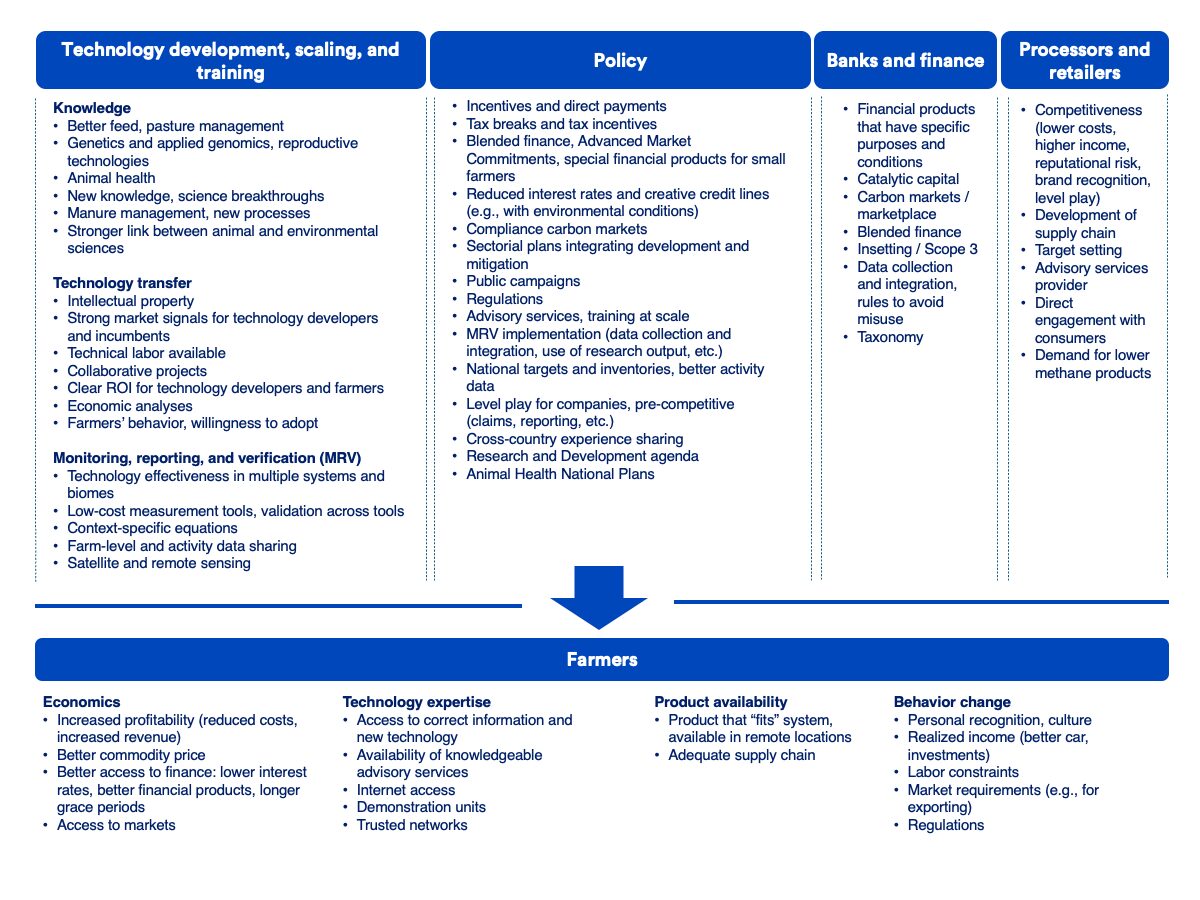
Methane reduction in agriculture will involve a mix of policy instruments including economic incentives, information sharing, and regulatory mechanisms targeting both farmers and related actors. These interventions aim to unlock productivity gains, reduce emissions, and enhance climate resilience.
Figure 1. Non-exhaustive summary of intervention points to accelerate methane emission reductions in livestock sector (refer to original source for detailed illustration).
Learning from Existing Models: Brazil’s Programa Mais Leite Saudável
Brazil’s Programa Mais Leite Saudável exemplifies how aligned incentives can drive large-scale change. The program grants tax credits to dairy processors investing in technical assistance for farmers, mobilizing industry participation and improving farmer practices. Since 2015, over 394,000 dairy farmers have benefited from more than 2,000 projects across 1,000 municipalities, supported by governance and verification systems.
This model demonstrates the potential for methane-focused initiatives that align with SDG 9 (Industry, Innovation and Infrastructure) and SDG 12 (Responsible Consumption and Production).
Need for Enhanced Evidence and Policy Innovation
There is an urgent need for comprehensive data and research on the economic and social impacts of policies combining agricultural development and methane mitigation. Strengthening the evidence base supports the design of innovative policies that simultaneously deliver climate adaptation, mitigation, and economic growth.
Role of Philanthropy and Civil Society in Advancing Agricultural Methane Policy
Philanthropic organizations and civil society have catalyzed global methane action, exemplified by the establishment of the Global Methane Hub and tools like CATF’s Country Methane Abatement Tool. Philanthropy also promotes innovation in methane reduction technologies for livestock and rice production.
Effective policy integration requires collaboration among NGOs, governments, and agricultural stakeholders to design policies that promote continuous agricultural growth, food security, and methane mitigation, aligning with SDG 17 (Partnerships for the Goals).
Plan to Accelerate Integrated Action
CATF co-leads the Plan to Accelerate (PAS) “Integrating Agricultural Development and Methane Mitigation” with the Climate and Clean Air Coalition (CCAC) and Environmental Defense Fund (EDF). Hosted under CCAC’s Farmers’ Initiative for Resilient and Sustainable Transformations (FIRST), PAS aims to empower actors at the farm level by providing case studies and strategic information to support policy development and advocacy.
Conclusion
- Agriculture, as the largest source of human-made methane, requires urgent, integrated action combining development and methane mitigation policies.
- Pragmatic policy development and implementation targeting multiple agricultural stakeholders are essential for success.
- Improving the evidence base on policy impacts for productivity, income, and emissions reduction is critical.
- Funding applied research, policy evaluation, and advocacy efforts will support sustainable agricultural growth and climate goals.
- Collaboration across sectors and actors is vital to address the complexity of agricultural methane mitigation effectively.
These efforts contribute directly to achieving multiple Sustainable Development Goals, particularly SDG 2 (Zero Hunger), SDG 8 (Decent Work and Economic Growth), SDG 12 (Responsible Consumption and Production), SDG 13 (Climate Action), and SDG 17 (Partnerships for the Goals).
1. Sustainable Development Goals (SDGs) Addressed in the Article
- SDG 2: Zero Hunger – The article discusses increasing food production and productivity, particularly in livestock, which directly relates to achieving food security and sustainable agriculture.
- SDG 12: Responsible Consumption and Production – The focus on reducing methane emissions from agriculture and promoting sustainable livestock production aligns with sustainable consumption and production patterns.
- SDG 13: Climate Action – The article emphasizes methane mitigation in agriculture as a critical climate action to reduce greenhouse gas emissions and combat climate change.
- SDG 15: Life on Land – Sustainable agricultural practices and mitigation of methane emissions contribute to the protection and restoration of terrestrial ecosystems.
- SDG 17: Partnerships for the Goals – The article highlights the role of collaboration among governments, NGOs, civil society, and philanthropy in advancing methane reduction policies and technologies.
2. Specific Targets Under the Identified SDGs
- SDG 2 Targets:
- Target 2.3: By 2030, double the agricultural productivity and incomes of small-scale food producers, including through secure and equal access to land, technology, and markets.
- Target 2.4: Ensure sustainable food production systems and implement resilient agricultural practices that increase productivity and production.
- SDG 12 Targets:
- Target 12.2: Achieve the sustainable management and efficient use of natural resources.
- Target 12.4: Achieve environmentally sound management of chemicals and all wastes throughout their life cycle to minimize adverse impacts on human health and the environment.
- SDG 13 Targets:
- Target 13.2: Integrate climate change measures into national policies, strategies, and planning.
- Target 13.3: Improve education, awareness-raising, and human and institutional capacity on climate change mitigation, adaptation, impact reduction, and early warning.
- SDG 15 Targets:
- Target 15.3: Combat desertification, restore degraded land and soil, including land affected by desertification, drought, and floods, and strive to achieve a land degradation-neutral world.
- SDG 17 Targets:
- Target 17.16: Enhance the global partnership for sustainable development, complemented by multi-stakeholder partnerships.
- Target 17.17: Encourage and promote effective public, public-private, and civil society partnerships.
3. Indicators Mentioned or Implied to Measure Progress
- Indicator for SDG 2.3: Agricultural productivity and income levels of farmers, as the article discusses increasing productivity sustainably and improving farmer incomes.
- Indicator for SDG 2.4: Adoption rates of sustainable agricultural practices and technologies that reduce methane emissions.
- Indicator for SDG 12.2 and 12.4: Quantifiable reduction in methane emissions from livestock agriculture; presence and coverage of policies targeting methane emissions.
- Indicator for SDG 13.2: Number of countries including agricultural methane reduction measures in their Nationally Determined Contributions (NDCs) and existence of sectoral plans for implementation.
- Indicator for SDG 13.3: Capacity building activities, policy development, and advocacy efforts supporting methane mitigation in agriculture.
- Indicator for SDG 17.16 and 17.17: Number and effectiveness of partnerships and collaborations among governments, NGOs, civil society, and philanthropic organizations in methane mitigation initiatives.
- Additional Indicators:
- Percentage of global methane emissions covered by policies (currently 13% overall, 17% in agriculture).
- Number of farmers adopting methane-reducing technologies and practices.
- Monitoring, reporting, and verification systems for methane emissions in agriculture.
4. Table of SDGs, Targets, and Indicators
| SDGs | Targets | Indicators |
|---|---|---|
| SDG 2: Zero Hunger |
|
|
| SDG 12: Responsible Consumption and Production |
|
|
| SDG 13: Climate Action |
|
|
| SDG 15: Life on Land |
|
|
| SDG 17: Partnerships for the Goals |
|
|
Source: catf.us
What is Your Reaction?
 Like
0
Like
0
 Dislike
0
Dislike
0
 Love
0
Love
0
 Funny
0
Funny
0
 Angry
0
Angry
0
 Sad
0
Sad
0
 Wow
0
Wow
0