





































;Resize=620#)













On Brazil’s Combu Island, chocolate makers hold clues to climate action – UN News
Report on Community-Led Sustainable Development on Combu Island
A Case Study for Global Climate Action and the Sustainable Development Goals
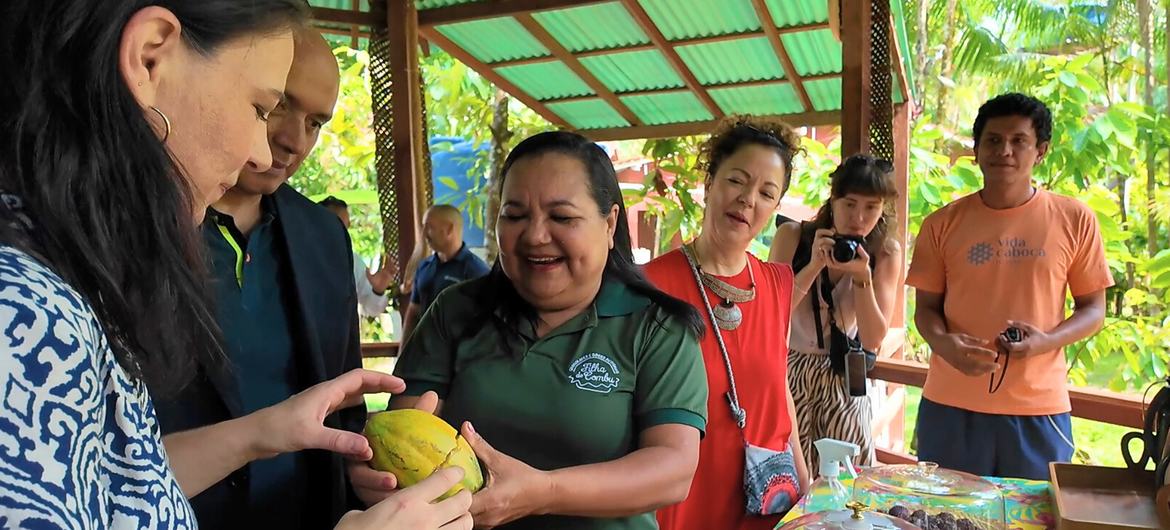
A community-led initiative on Combu Island, near the COP30 host city of Belém, Brazil, serves as a critical model for integrating environmental protection with sustainable economic development. The Filha do Combu Association, founded by Izete Costa (Dona Nena), demonstrates that safeguarding forest ecosystems is intrinsically linked to empowering the local communities who act as their stewards. This project offers a tangible framework for achieving multiple Sustainable Development Goals (SDGs) ahead of global climate negotiations.
Project Analysis: The Filha do Combu Association
Economic Empowerment and Social Inclusion
The association’s success in turning traditional knowledge into a thriving chocolate enterprise directly addresses several key SDGs.
- SDG 1 (No Poverty) & SDG 8 (Decent Work and Economic Growth): The project has evolved from small-scale local sales to a formal enterprise, creating sustainable livelihoods and income for the community.
- SDG 5 (Gender Equality): The initiative demonstrates a strong commitment to women’s empowerment, with women comprising 16 of the 20 employees. This highlights the role of women as leaders in community-based climate solutions.
Sustainable Production and Environmental Stewardship
The operational model is founded on principles of ecological harmony and responsible resource management, aligning with environmental SDGs.
- SDG 15 (Life on Land): The project utilizes an agroecological system that works in concert with the existing rainforest. As stated by its founder, “We work with the forest standing,” enriching the ecosystem rather than clearing it for agriculture.
- SDG 12 (Responsible Consumption and Production): The production of chocolate from Amazonian cacao follows a sustainable, closed-loop model, promoting responsible use of natural resources.
- SDG 7 (Affordable and Clean Energy): The factory operates for eight hours daily on solar power, showcasing a commitment to clean energy. However, reliance on an unstable electrical grid presents a significant operational challenge.
Challenges and Climate Vulnerability
Impacts on a Sustainable Model
Despite its sustainable design, the Combu Island project is vulnerable to systemic and environmental challenges that threaten its progress and highlight the urgency of global climate action.
- Infrastructure Deficits: Power outages caused by grid instability can halt production for days, underscoring the need for increased investment in resilient, clean energy infrastructure like expanded solar capacity.
- Climate Change Impacts (SDG 13: Climate Action): The community is experiencing direct consequences of climate change, including prolonged droughts during the rainy season and diminished cacao harvests, with fruits drying and deforming. This threatens both the local water supply and the economic foundation of the enterprise.
Global Policy Implications for COP30
From Local Solutions to Global Frameworks
The visit by Annalena Baerbock, President of the 80th session of the UN General Assembly, underscored the project’s global significance. The initiative is presented as proof that solutions uniting economic growth and climate action already exist.
Key Takeaways for Global Negotiators:
- Scaling Up Community Models: Ms. Baerbock emphasized that connecting and scaling up local, sustainable models is essential to achieving global climate targets, particularly the goal of limiting warming to 1.5°C.
- Partnerships for the Goals (SDG 17): The success of COP30 will depend on fostering collaboration between governments, financial actors, businesses, and local communities to implement sustainable growth models that benefit all.
- Human-Centered Conservation: The core lesson from Combu Island is that forest protection is inseparable from the well-being of its inhabitants. As Ms. Baerbock warned, “Forest destruction is the destruction of humanity’s life insurance.” Safeguarding indigenous and local peoples is a prerequisite for preserving global ecosystems.
Analysis of Sustainable Development Goals in the Article
1. Which SDGs are addressed or connected to the issues highlighted in the article?
-
SDG 5: Gender Equality
- The article highlights the empowerment of women through economic opportunities. It explicitly states that of the 20 workers employed at the Filha do Combu Association, “16 are women.” It also mentions the project’s “emphasis on empowering the women who sell their products” and their “unique energy of care and dedication.”
-
SDG 7: Affordable and Clean Energy
- The chocolate factory’s reliance on renewable energy is a key point. The article notes that the factory “runs eight hours a day on solar energy” and that the owner, Dona Nena, “hopes to double solar capacity” to ensure steady production.
-
SDG 8: Decent Work and Economic Growth
- The article showcases a community-led enterprise that turns “traditional knowledge into income.” The Filha do Combu Association has grown into a “thriving enterprise” that creates local jobs (20 workers) and promotes sustainable tourism, demonstrating a model for inclusive and sustainable economic growth.
-
SDG 12: Responsible Consumption and Production
- The production system is described as “agroecological,” where native species are used to strengthen yields without deforestation. This method represents a sustainable pattern of production that works in harmony with the local ecosystem.
-
SDG 13: Climate Action
- The entire article is framed around the upcoming COP30 climate conference. It presents the community-led initiative as a “solution that unite[s] economic growth, sustainable development and the fight against the climate crisis.” It also discusses the direct impacts of climate change, such as shrinking cacao harvests and prolonged droughts.
-
SDG 15: Life on Land
- The core principle of the initiative is forest conservation. Dona Nena states, “we didn’t cut down the forest to plant trees. We work with the forest standing.” This directly addresses the goal of sustainably managing forests, halting deforestation, and protecting biodiversity. The warning that “Forest destruction is the destruction of humanity’s life insurance” reinforces this connection.
-
SDG 17: Partnerships for the Goals
- The article describes the visit of Annalena Baerbock, President of the 80th session of the UN General Assembly, highlighting a partnership between a local community project and a global leader. Her call for “businesses, finance actors” to join hands to “fight the climate crisis” emphasizes the need for multi-stakeholder partnerships to achieve sustainable development.
2. What specific targets under those SDGs can be identified based on the article’s content?
-
Under SDG 5 (Gender Equality):
- Target 5.5: Ensure women’s full and effective participation and equal opportunities for leadership in political, economic and public life. The article demonstrates this through Dona Nena’s leadership as the founder of the association and the high proportion of female employees (16 out of 20).
-
Under SDG 7 (Affordable and Clean Energy):
- Target 7.2: By 2030, increase substantially the share of renewable energy in the global energy mix. The factory’s use of solar power and its goal to double this capacity directly contribute to this target on a local scale.
-
Under SDG 8 (Decent Work and Economic Growth):
- Target 8.5: By 2030, achieve full and productive employment and decent work for all women and men. The creation of 20 jobs in a local community enterprise is a direct example.
- Target 8.9: By 2030, devise and implement policies to promote sustainable tourism that creates jobs and promotes local culture and products. The initiative includes a “tourism programme that invites visitors to see how chocolate is made in the rainforest.”
-
Under SDG 12 (Responsible Consumption and Production):
- Target 12.2: By 2030, achieve the sustainable management and efficient use of natural resources. The “agroecological” production system, which works with the existing forest, exemplifies this target.
-
Under SDG 13 (Climate Action):
- Target 13.1: Strengthen resilience and adaptive capacity to climate-related hazards and natural disasters in all countries. The article mentions the community is already facing climate impacts like shrinking harvests and drought, and the project’s sustainability efforts are a form of building resilience.
-
Under SDG 15 (Life on Land):
- Target 15.2: By 2020, promote the implementation of sustainable management of all types of forests, halt deforestation, restore degraded forests and substantially increase afforestation and reforestation globally. The project’s philosophy to “work with the forest standing” and enrich it where there is “natural decline” directly aligns with this target.
-
Under SDG 17 (Partnerships for the Goals):
- Target 17.17: Encourage and promote effective public, public-private and civil society partnerships. The collaboration and dialogue between the local community leader (Dona Nena) and a global political figure (Annalena Baerbock) to showcase a scalable solution is an example of such a partnership.
3. Are there any indicators mentioned or implied in the article that can be used to measure progress towards the identified targets?
-
For SDG 5 (Gender Equality):
- Indicator: Proportion of women in managerial and non-managerial positions. The article provides a specific number: “16 are women” out of 20 total workers, which is an 80% female workforce.
-
For SDG 7 (Affordable and Clean Energy):
- Indicator: Share of renewable energy in total final energy consumption. The article implies this can be measured by stating the factory “runs eight hours a day on solar energy” and has a goal to “double solar capacity.”
-
For SDG 8 (Decent Work and Economic Growth):
- Indicator: Number of jobs created. The article specifies that “20 workers” are employed at the site.
-
For SDG 13 (Climate Action):
- Indicator: Number of countries with nationally determined contributions, long-term strategies, national adaptation plans and adaptation communications. The reference to COP30 and keeping warming to 1.5°C points to this global indicator.
- Indicator (Implied): Changes in agricultural yield and water availability. The article mentions that “cacao harvests have shrunk” and the “fear of losing access to drinking water grows,” suggesting these are local metrics for climate impact.
-
For SDG 15 (Life on Land):
- Indicator (Implied): Progress towards sustainable forest management. While no specific number is given, the qualitative description of “work[ing] with the forest standing” and not cutting down trees implies a measure of forest area conserved or managed sustainably.
4. Table of SDGs, Targets, and Indicators
| SDGs | Targets | Indicators |
|---|---|---|
| SDG 5: Gender Equality | 5.5: Ensure women’s full and effective participation and equal opportunities for leadership. | Proportion of women in the workforce (16 out of 20, or 80%). |
| SDG 7: Affordable and Clean Energy | 7.2: Increase substantially the share of renewable energy. | Use of solar power for 8 hours a day; goal to double solar capacity. |
| SDG 8: Decent Work and Economic Growth | 8.5: Achieve full and productive employment and decent work for all. 8.9: Promote sustainable tourism. |
Creation of 20 local jobs; establishment of a tourism program. |
| SDG 12: Responsible Consumption and Production | 12.2: Achieve the sustainable management and efficient use of natural resources. | Implementation of an “agroecological” production system. |
| SDG 13: Climate Action | 13.1: Strengthen resilience and adaptive capacity to climate-related hazards. | Observed impacts like shrinking cacao harvests and drought, indicating a need for adaptation. |
| SDG 15: Life on Land | 15.2: Promote the implementation of sustainable management of all types of forests, halt deforestation. | The practice of “work[ing] with the forest standing” without clearing land. |
| SDG 17: Partnerships for the Goals | 17.17: Encourage and promote effective public, public-private and civil society partnerships. | Dialogue and visit between a local entrepreneur and a high-level UN official to promote scalable solutions. |
Source: news.un.org
What is Your Reaction?
 Like
0
Like
0
 Dislike
0
Dislike
0
 Love
0
Love
0
 Funny
0
Funny
0
 Angry
0
Angry
0
 Sad
0
Sad
0
 Wow
0
Wow
0