










































;Resize=620#)







Rainwater Harvesting Market Set to Reach USD 1.5 Bn by 2031 Amid – openPR.com
Global Rainwater Harvesting Market Report: A Focus on Sustainable Development Goals
Executive Summary
The global rainwater harvesting market is experiencing significant growth, driven by increasing water scarcity and climate change. This report analyzes the market’s trajectory, its key drivers, and its profound alignment with the United Nations’ Sustainable Development Goals (SDGs), particularly SDG 6 (Clean Water and Sanitation), SDG 11 (Sustainable Cities and Communities), and SDG 13 (Climate Action). The market is transitioning from an alternative water source to a critical component of sustainable water management infrastructure worldwide.
Market Overview and Projections
According to recent research, the global rainwater harvesting market demonstrates a robust growth forecast, underscoring its increasing importance in global water strategy.
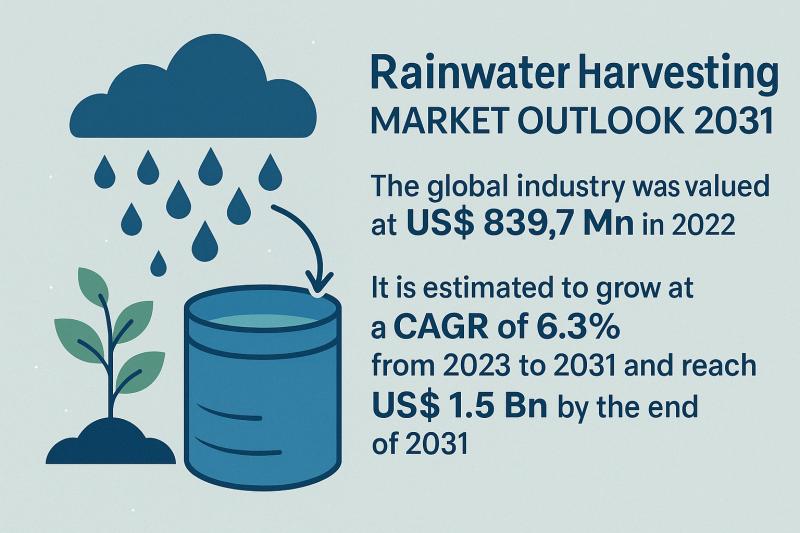
- 2022 Market Valuation: US$ 839.7 Million
- 2031 Projected Valuation: US$ 1.5 Billion
- Compound Annual Growth Rate (CAGR): 6.3% (2023-2031)
This expansion is propelled by technological advancements in filtration, purification, and smart monitoring systems, alongside a rise in community-based and government-led initiatives.
Alignment with Sustainable Development Goals (SDGs)
SDG 6: Clean Water and Sanitation
Rainwater harvesting directly supports the targets of SDG 6 by providing a decentralized, reliable, and environmentally responsible water source. Its contributions include:
- Reducing pressure on strained municipal water supply systems.
- Enhancing water availability in regions facing scarcity and drought.
- Replenishing groundwater aquifers, a critical component of freshwater reserves.
- Providing a low-energy alternative to centralized water treatment and distribution.
SDG 11: Sustainable Cities and Communities
The integration of rainwater harvesting systems into urban planning is crucial for building resilient and sustainable cities. This practice helps achieve SDG 11 by:
- Mitigating urban flooding and managing stormwater runoff effectively.
- Lowering the costs associated with developing large-scale urban water infrastructure.
- Supporting green building initiatives (e.g., LEED certification) by providing water for non-potable uses like landscaping, cooling systems, and flushing.
SDG 13: Climate Action
As a key climate adaptation strategy, rainwater harvesting addresses the challenges posed by climate-induced variations in rainfall patterns. It strengthens resilience by:
- Securing water supplies during prolonged drought cycles and periods of erratic rainfall.
- Reducing dependency on climate-vulnerable water sources like glaciers and rivers.
- Decreasing the energy consumption and carbon footprint associated with pumping and treating water over long distances.
Market Drivers and Key Growth Factors
Climate-Induced Water Scarcity
The primary driver for market expansion is the global water crisis, exacerbated by climate change. Key pressures accelerating the adoption of rainwater harvesting include:
- Erratic rainfall patterns and long-term droughts.
- Rising temperatures leading to accelerated evaporation.
- Reduced freshwater availability from traditional sources like melting glaciers.
- Saltwater intrusion into coastal aquifers due to rising sea levels.
Government Initiatives and Policy Support
Global and national policy frameworks are strengthening the market outlook. Governments are promoting adoption through:
- Mandating the installation of rainwater harvesting systems in new constructions.
- Offering tax rebates, subsidies, and financial incentives.
- Launching public awareness and training campaigns.
- Integrating rainwater harvesting into smart city and sustainable development programs, in line with SDG commitments.
Market Segmentation Analysis
By Harvesting Method
- Above Ground Systems: This is the dominant segment due to lower installation costs, ease of maintenance, and suitability for retrofitting. These systems are widely used for gardening, vehicle washing, and emergency supply.
- Below Ground Systems: Preferred in space-constrained urban environments, these systems offer larger storage capacity but entail higher installation costs.
By Application
- Residential: Growing adoption in households to combat urban water shortages.
- Commercial: High potential in malls, offices, hotels, and hospitals for non-potable water needs.
- Industrial: Used for cooling, washing, and processing, reducing operational utility expenses.
- Agricultural: Enhances crop resilience by supplementing irrigation water, contributing to food security (SDG 2).
Regional Outlook and SDG Implementation
Asia Pacific
The Asia Pacific region leads the global market, driven by rapid urbanization, government mandates, and high population density. Community-driven initiatives in countries like India and China are pivotal in achieving water security at a local level.
Europe and North America
Growth in these regions is linked to strong environmental policies and green building standards. Drought-prone areas in the U.S. (California, Texas) are increasingly adopting these systems as a water conservation measure.
Middle East, Africa, and Latin America
In these regions, severe water scarcity and the high cost of desalination make rainwater harvesting a critical and cost-effective solution for domestic, commercial, and agricultural applications.
Competitive Landscape and Future Outlook
The market is moderately fragmented, featuring a mix of global and regional players focused on innovation in filtration, smart monitoring, and purification technologies. Key industry players include:
- Kingspan Group Plc Ltd
- Watts Water Technologies Inc.
- Otto Graf GmbH Kunststofferzeugnisse
- WISY AG
- Innovative Water Solutions LLC
- D&D Ecotech Services
- Rain Harvesting Supplies, Inc.
- Water Field Technologies Pvt. Ltd
The market’s future is tied to continued international collaboration, such as the EU LIFE funding for rainwater reuse and the UNEP-led Rooftop Rainwater Harvesting Alliance, which will accelerate adoption and further embed rainwater harvesting as a cornerstone of sustainable development.
Analysis of Sustainable Development Goals in the Article
1. Which SDGs are addressed or connected to the issues highlighted in the article?
-
SDG 6: Clean Water and Sanitation
- The article explicitly mentions “The UN’s Sustainable Development Goal (SDG 6) promotes water conservation through decentralized systems.” The entire article is centered on rainwater harvesting as a solution to water scarcity, reducing pressure on municipal supplies, and providing a sustainable water source, which are core themes of SDG 6.
-
SDG 11: Sustainable Cities and Communities
- The article discusses the role of rainwater harvesting in urban settings. It mentions reducing pressure on “municipal supply systems,” lowering “urban water infrastructure costs,” mitigating “flooding and stormwater runoff,” and the “integration of rainwater harvesting into smart city programs.” These points directly relate to making cities more sustainable and resilient.
-
SDG 13: Climate Action
- The article identifies “rapid climate variations,” “climate-induced changes in rainfall patterns,” “long-term drought cycles,” and “accelerated evaporation from rising temperatures” as key drivers for the rainwater harvesting market. It frames rainwater harvesting as a critical tool for “climate adaptation frameworks,” thus directly addressing climate action.
-
SDG 9: Industry, Innovation, and Infrastructure
- The article highlights that the market is “increasingly technology-driven, with substantial advancements in filtration media, purification systems, membrane technologies, and smart monitoring.” It also presents rainwater harvesting as a form of decentralized, resilient infrastructure that reduces dependency on centralized systems, aligning with the goal of building sustainable infrastructure.
2. What specific targets under those SDGs can be identified based on the article’s content?
-
Under SDG 6 (Clean Water and Sanitation):
- Target 6.4: By 2030, substantially increase water-use efficiency across all sectors and ensure sustainable withdrawals and supply of freshwater to address water scarcity. The article supports this by describing how rainwater harvesting is used in residential, commercial, industrial, and agricultural sectors to provide an alternative water source, thus reducing reliance on and improving the overall efficiency of freshwater use.
- Target 6.b: Support and strengthen the participation of local communities in improving water and sanitation management. This is identified through the mention of a “surge in community-based initiatives” and “Community-driven initiatives and NGO-led programs” that support market growth, particularly in Asia Pacific.
-
Under SDG 11 (Sustainable Cities and Communities):
- Target 11.5: By 2030, significantly reduce the … economic losses … caused by disasters, including water-related disasters. The article directly connects to this target by stating that rainwater harvesting contributes to the “mitigation of flooding and stormwater runoff,” which are common urban water-related disasters.
-
Under SDG 13 (Climate Action):
- Target 13.1: Strengthen resilience and adaptive capacity to climate-related hazards and natural disasters in all countries. The article positions rainwater harvesting as a key strategy to build resilience against climate impacts like “erratic rainfall patterns” and “long-term drought cycles,” referring to it as a component of “climate adaptation frameworks.”
3. Are there any indicators mentioned or implied in the article that can be used to measure progress towards the identified targets?
-
Indicators for Target 6.4 (Water-use efficiency):
- Market Growth and Value: The projection that the “global rainwater harvesting market… is projected to reach US$ 1.5 Bn by 2031, expanding at a CAGR of 6.3%” serves as a proxy indicator for the rate of adoption of water-saving technologies.
- Volume of Water Saved: A direct indicator is mentioned in a specific case: “Johor Port (Malaysia) installed a rainwater harvesting system saving 10 million liters of freshwater annually.” This quantifies the increase in water-use efficiency.
-
Indicators for Target 6.b (Community Participation):
- Number of Community-led Projects: The article implies this indicator by mentioning a “surge in community-based initiatives” and “NGO-led programs” as key market drivers, suggesting that tracking the number and scale of these projects would measure progress.
-
Indicators for Targets 11.5 and 13.1 (Resilience and Adaptation):
- Implementation of Government Policies: The article lists several government actions that can be tracked, such as the number of municipalities with “Mandatory installation of rainwater harvesting in new buildings,” the value of “Tax rebates and subsidies,” and the integration of these systems into “smart city programs.”
- Level of Investment: Funding for adaptation projects is a clear indicator. The article provides an example: “A Dutch-Spanish consortium received US$ 3.26 Mn in EU LIFE funding to scale rainwater reuse technologies.” The rising funding from the UN and World Bank is also noted.
SDGs, Targets and Indicators Summary
| SDGs | Targets | Indicators |
|---|---|---|
| SDG 6: Clean Water and Sanitation | Target 6.4: Increase water-use efficiency and address water scarcity. |
|
| Target 6.b: Support and strengthen the participation of local communities. |
|
|
| SDG 11: Sustainable Cities and Communities | Target 11.5: Reduce economic losses from water-related disasters. |
|
| SDG 13: Climate Action | Target 13.1: Strengthen resilience and adaptive capacity to climate-related hazards. |
|
| SDG 9: Industry, Innovation, and Infrastructure | Target 9.1: Develop sustainable and resilient infrastructure. |
|
Source: openpr.com
What is Your Reaction?
 Like
0
Like
0
 Dislike
0
Dislike
0
 Love
0
Love
0
 Funny
0
Funny
0
 Angry
0
Angry
0
 Sad
0
Sad
0
 Wow
0
Wow
0