




































UCF’s Commitment to Affordable Learning – University of Central Florida
Report on UCF’s Affordable Instructional Materials (AIM) Initiative and Its Alignment with Sustainable Development Goals
Introduction
The University of Central Florida (UCF) has implemented the Affordable Instructional Materials (AIM) initiative, a strategic program designed to reduce the financial burden of educational resources on students. This initiative directly supports several United Nations Sustainable Development Goals (SDGs), particularly SDG 4 (Quality Education), SDG 10 (Reduced Inequalities), and SDG 17 (Partnerships for the Goals).
Key Achievements of the AIM Initiative
- Since 2019, AIM has saved students over $50 million in costs related to textbooks, access codes, and digital platforms, thereby removing significant barriers to academic success.
- AIM empowers faculty by providing resources and support to adopt free or low-cost instructional materials, fostering accessible and engaging course design.
- In 2026, a record 1,519 faculty members were recognized at the AIM High Impact Awards for their commitment to affordability and student success.
University-Wide Collaborative Effort
AIM represents a comprehensive, university-wide collaboration involving:
- Division of Digital Learning
- UCF Libraries
- Office of the Provost and Academic Affairs
- Faculty Center for Teaching and Learning
- UCF Bookstore
- Other university stakeholders
This collaboration aligns with SDG 17 by fostering partnerships that enhance educational access and quality.
Impact and Reach
- In 2025, 18,878 course sections (76.5% of all sections) utilized low- or no-cost course materials.
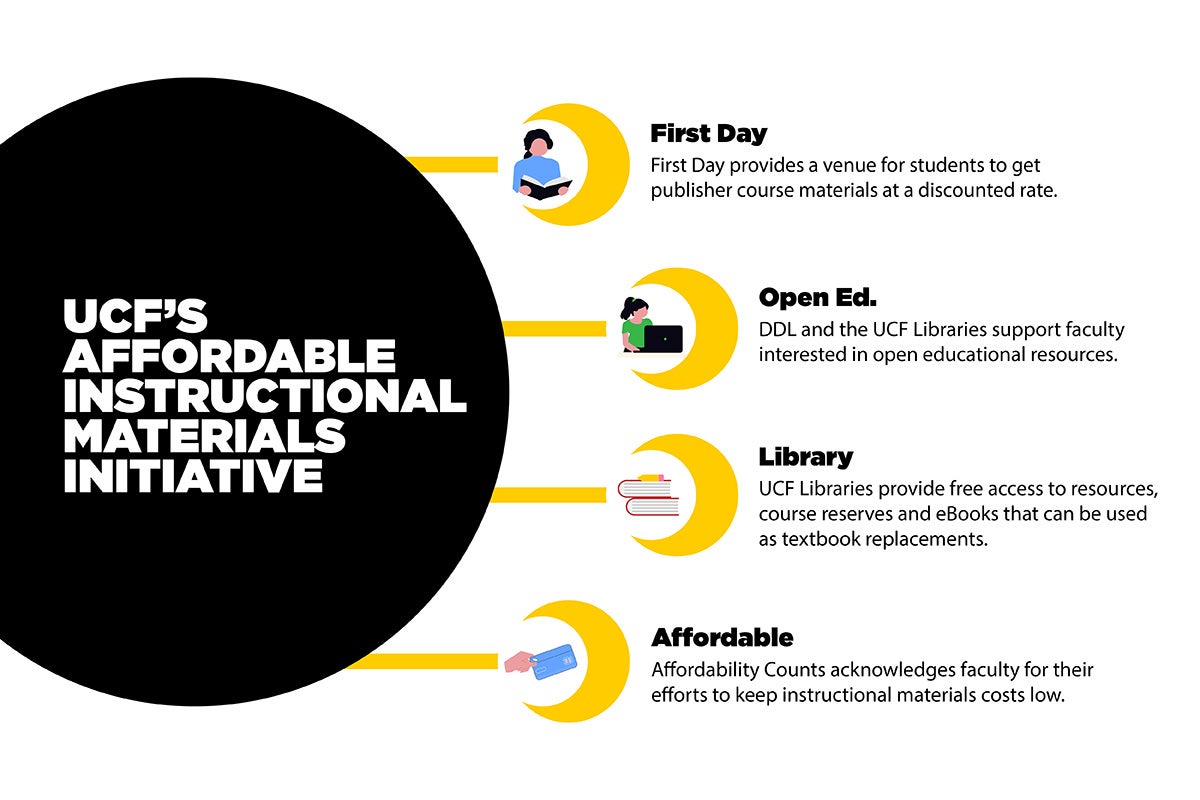
- AIM focuses on four core areas: First Day materials, Open Educational Resources (OER), library-sourced materials, and affordability counts, enabling faculty to create interactive and accessible courses.
- The initiative promotes innovative teaching methods that enhance student engagement and academic excellence, supporting SDG 4.
Recognition of Faculty Contributions to Affordable Learning
2026 AIM High Impact Awards
The annual AIM High Impact Awards celebrate faculty and staff who advance affordable learning. The 2026 awards highlighted the following categories and recipients:
Individual Rising Award
Assistant Professor Debaleena Majumdar was recognized for her course EVR 3733: Introduction to Sustainable Design, which integrates zero-cost resources such as library eBooks, scholarly articles, videos, and web-based materials. This course exemplifies SDG 4 by promoting inclusive and equitable quality education.
Individual Legacy Award
Associate Professor Samar Younes was honored for her innovative use of open educational resources and instructor-created content across engineering courses. Her development of free instructional videos and AI-generated practice tools enhances learning accessibility and affordability, advancing SDG 9 (Industry, Innovation and Infrastructure) and SDG 4.
Group Legacy Award
The First-Year Composition Program in the College of Arts and Humanities demonstrated affordability at scale by serving over 17,700 students and generating over $2.6 million in textbook savings. The program’s collaboration with UCF Libraries to provide no-cost materials supports SDG 4 and SDG 17.
Knights’ Choice Award
Lecturer Joseph Wachowski was nominated by students for his commitment to free, accessible course materials. His work fosters equity and innovation in education, aligning with SDG 4 and SDG 10.
Alignment with Sustainable Development Goals
- SDG 4: Quality Education – AIM ensures inclusive and equitable quality education by removing financial barriers and promoting accessible learning materials.
- SDG 10: Reduced Inequalities – By lowering costs, AIM reduces educational inequalities among students from diverse socioeconomic backgrounds.
- SDG 9: Industry, Innovation and Infrastructure – The initiative encourages innovative teaching methods and the use of technology to enhance learning.
- SDG 17: Partnerships for the Goals – AIM exemplifies effective partnerships across university departments to achieve shared educational goals.
Conclusion
UCF’s AIM initiative represents a model of how higher education institutions can integrate sustainable development principles into academic practices. By prioritizing affordability, accessibility, and innovation, AIM contributes significantly to the achievement of the Sustainable Development Goals, particularly in fostering quality education and reducing inequalities.
Further Information
Faculty interested in participating in or learning more about the AIM initiative are encouraged to contact affordable@ucf.edu.
1. Sustainable Development Goals (SDGs) Addressed or Connected
-
SDG 4: Quality Education
- The article focuses on improving access to affordable instructional materials, which directly supports inclusive and equitable quality education.
- Efforts to remove financial barriers for students align with SDG 4’s emphasis on ensuring equal access to education.
-
SDG 10: Reduced Inequalities
- By reducing costs of textbooks and course materials, the initiative helps lower economic inequalities among students.
- Supports marginalized or financially disadvantaged students to succeed academically.
-
SDG 17: Partnerships for the Goals
- The article describes a university-wide collaboration involving multiple departments and stakeholders, reflecting partnerships to achieve sustainable development.
2. Specific Targets Under Identified SDGs
-
SDG 4 Targets
- 4.3: Ensure equal access for all women and men to affordable and quality technical, vocational and tertiary education, including university.
- 4.5: Eliminate gender disparities and ensure equal access to all levels of education and vocational training for vulnerable populations.
- 4.7: Ensure that all learners acquire knowledge and skills needed to promote sustainable development.
-
SDG 10 Targets
- 10.2: Empower and promote the social, economic and political inclusion of all, irrespective of age, sex, disability, race, ethnicity, origin, religion or economic or other status.
-
SDG 17 Targets
- 17.16: Enhance the global partnership for sustainable development, complemented by multi-stakeholder partnerships that mobilize and share knowledge, expertise, technology and financial resources.
3. Indicators Mentioned or Implied to Measure Progress
-
Cost Savings for Students
- Over $50 million saved in instructional materials costs since 2019.
- Specific savings such as $2.6 million in textbook cost savings for the First-Year Composition Program and $371,061 for engineering courses.
- These monetary savings serve as indicators of affordability and access improvements.
-
Faculty Participation and Course Sections Using Affordable Materials
- 1,519 faculty members recognized for affordable materials use.
- 18,878 course sections (76.5% of all sections) utilized low- or no-cost materials in 2025.
- These figures indicate institutional adoption and scale of affordable education practices.
-
Student Reach and Engagement
- More than 17,700 students served by the First-Year Composition Program using affordable materials.
- Student feedback and nominations for awards reflect qualitative measures of impact on academic success.
-
Quality and Accessibility Designations
- Courses earning Affordability Counts medallion and Quality Online course designation indicate quality and accessibility standards.
4. Table of SDGs, Targets, and Indicators
| SDGs | Targets | Indicators |
|---|---|---|
| SDG 4: Quality Education |
|
|
| SDG 10: Reduced Inequalities |
|
|
| SDG 17: Partnerships for the Goals |
|
|
Source: ucf.edu
What is Your Reaction?
 Like
0
Like
0
 Dislike
0
Dislike
0
 Love
0
Love
0
 Funny
0
Funny
0
 Angry
0
Angry
0
 Sad
0
Sad
0
 Wow
0
Wow
0